Sunday, May 14, 2023

May 12 - Faith and Begorrah, we’re in Ireland today

The days are starting to run together and I confess I’m getting tired with a port every day.  It isn’t too bad if the daily ports are Caribbean islands, but I’ve never been to any of these and I have a compulsion to see as much as I can. Today we are tendering into Greencastle, County Donegal, Ulster, Republic of Ireland. In other words I have set foot in Ireland; before I’d only been to Northern Ireland.

Greencastle is a little fishing village and it didn’t look like it had much to see. I booked a tour to take me to Londonderry and a place called Oakfield Park which has gardens that you see via a small train. It isn’t raining but it is cloudy and actually not cold.  In fact on the bus we were hot because the heat worked and couldn’t be turned off.


The Irish countryside is lush and beautiful.  We passed in and out of Northern Ireland which is part of the UK. Until the Good Friday Agreements were signed in April, 1998, there would have been border controls and checkpoints.  Now there’s just a difference in pavement and lines painted on the roads.  The area we passed through had nice looking homes and looked like it was reasonably prosperous as we drove along.


Our first stop was Derry, the second largest city in Northern Ireland.  Officially its name is Londonderry, but Irish Republicans and Catholics call it Derry.  Our guide Moira was Irish and though she didn’t say it, I’m willing to bet she’s Catholic.  I’ll say more about that later.  Derry is on the banks of the River Foyle and I wouldn’t describe it as particularly pretty.  Here I did see depressed looking areas.  It looks like a city which endured a lot during the “Troubles” between Catholics and Protestants for many years.

This and the next are of the Guild Hall. It looks like a cathedral to me.


We stopped for a photo opportunity at a square on one side of which was the old Guild Hall which looked like a cathedral.  It’s where trade guilds would meet in the past.  Now it’s where the Derry Council members meet.  I’m not sure I understand exactly what Moira said, but I believe there was a dispute of some kind among the various political parties operating in the city and one party walked out. The consequence is that there is currently no governing body. As she put it, where there is no structure, chaos and evil will fill the vacuum.  I had read that there had been two bombings in Derry in the last 6 weeks and she confirmed that was true.

This was the wall along one side of the square. In the picture below you can see the guns still in place there.


This was some of the nicer looking housing we saw in Derry.


We didn’t stay long in Derry and reboarded the bus and headed to Oakfield Park where we boarded a little steam train and rode very quickly around the gardens. What I saw were mostly woods. Not much had started blooming and the train didn’t slow down as we went past some picturesque stone bridges and lakes.  They were gone lickety-split before you could even focus a camera.  The gardens are owned by some “absentee” Sir and Lady something and they are trying to restore them to their Georgian splendor.

Our train that barreled down the tracks.

This and below were two places I tried to get pictures with limited success as we raced along.


As we drove back to Greencastle we drove along Lough (Loch) Foyle.  Close to the shoreline there were lots of mussel farms and traps of some kind which I'm guessing were to catch lobster or langoustines.  Interestingly, much of the seafood from here and Scotland gets shipped to France, Italy and Spain and can't be found here.

Traps to catch something

The shore from my veranda.  You can see it's pretty country but I think it's still very complicated in all respects.


Now about what I did find interesting about the tour.  As I said I’m practically positive that Moira is an Irish Republican Catholic.  She told us a lot about the treatment of Ireland for the hundreds of years the English owned the whole island.  She talked in length about the “starvation” in the 1840’s which most of us know as the Potato Famine. It resulted in the death of many Irish people and spurred the great migration to the US.  According to her, the event was not just a failure of the potato crops for five years, but also an engineered famine by the English to starve the Irish.  She said that other crops and livestock were forcibly exported so there was no food at all.  What she described sounded a lot like what Stalin did in the 1930’s to the Ukraine when millions there starved.  


Moira went on to describe the strife that went on in Northern Ireland until the Peace agreement in 1998.  I don’t know enough about the events that occurred to assess what she said and I would really like to hear the events as told by an Irish Protestant.  I know that terrible things happened but I felt as though I was hearing everything from only one perspective and I know that usually there are horrible things done by both sides of a dispute. She was fascinating to listen to and as a result I plan to read more about what went on in Ireland to try and have a better understanding of its history.  So for that reason I think the tour was worth doing.  I talked to some other passengers who were on the other bus that did the tour and their guide didn’t talk much so they thought the tour was a total waste.  Anytime I learn something or am prompted to read more about some place or time, then I think it’s worth the experience. I wouldn't book a cruise specifically because it stopped in Greencastle.  Enough said.


Saturday, May 13, 2023

May 11 - The Isle of Man

Our port today was Douglas, capital of the Isle of Man, located in the Irish Sea. I didn’t know until I came here today that the Isle of Man is not a part of the United Kingdom.  It's a crown dependency but it is self-governing and even has its own currency. Britain is responsible for Man’s defense, but the Isle of Man has its own parliament and makes its own laws. The parliament is called the Tynwald and according to the Manx people is the oldest continuous parliament in the world. Manx people are entitled to British passports but on the front of their passport it has the Isle of Man listed.  It’s truly a unique status.


The island has been inhabited since at least 6500 BC.  Over the millennia it has been settled by Gaelic people followed by Norsemen, Scots, and English.  The Norseman had a large influence on the island and the name of the parliament is derived from a Norse word. The island is pretty large, about 220 sq. miles, and has a population of close to 90,000 people.  The flag of the Isle of Man features a triskelion, an ancient symbol of three armored legs with golden spurs.  The triskelion dates back to ancient Greek times and depending on the culture can mean many different things but most commonly the celestial, physical and spiritual world.  It has been used on Man since the 13th century at least.

The Isle of Man flag


Man has no capital gains, wealth, inheritance or stamp taxes and a top income tax rate of 20% so it is no surprise that it’s a tax haven. It’s kind of a mini-Monaco. As a result of the tax advantages, the island is the home of many shell corporations and a large part of the economy is based on financial services and online gaming and things like movie production.  In the past agriculture and fishing were the principal economic activities along with tourism.  In the summer there still are many tourists because the island is very beautiful with lots of nice hiking paths and also because it’s the venue for one of the oldest and biggest motorbike races in the world, the Isle of Man TT.


My tour took me to the town of Peel which is the principal fishing village on the island and the home of a museum called the House of Manannan which tells the story of the settling of the island.  I like legends and of course this island has one, so here it is. Mannanan was a warrior and sea god according to local lore.  He and another character, a giant in Ireland called Finn McCool, got into an argument and Finn picked up a rock and threw it at Mannanan. When the rock landed in the sea the sea god turned it into the Isle of Man.  Legend has it that in Ireland there’s a lake that is the exact shape of Man and that’s the place that Finn plucked the rock from.  I’ve encountered this guy Finn years ago when Katie and I visited the Giant’s Causeway in Northern Ireland.  He was responsible for that too the story goes, so he was a busy giant.


The museum was interesting but I thought the ride across the island was better.  Along the way we passed a farm with a special kind of sheep only found here. They’re called Loaghtan sheep and they have brown coats and four, and  as many as six horns.  Even the ewes have horns.  I didn’t get a photo of them as we zoomed by but I’ll put one here from the internet.  The countryside was lush and green with lots of hedgerows of hawthorn bushes which were covered with white blossoms.


This is a two thirds of actual size Viking longboat and it was sailed from Trondheim in Norway to Peel in Isle of Man. This puts a whole new light on cruising.


Look at those horns


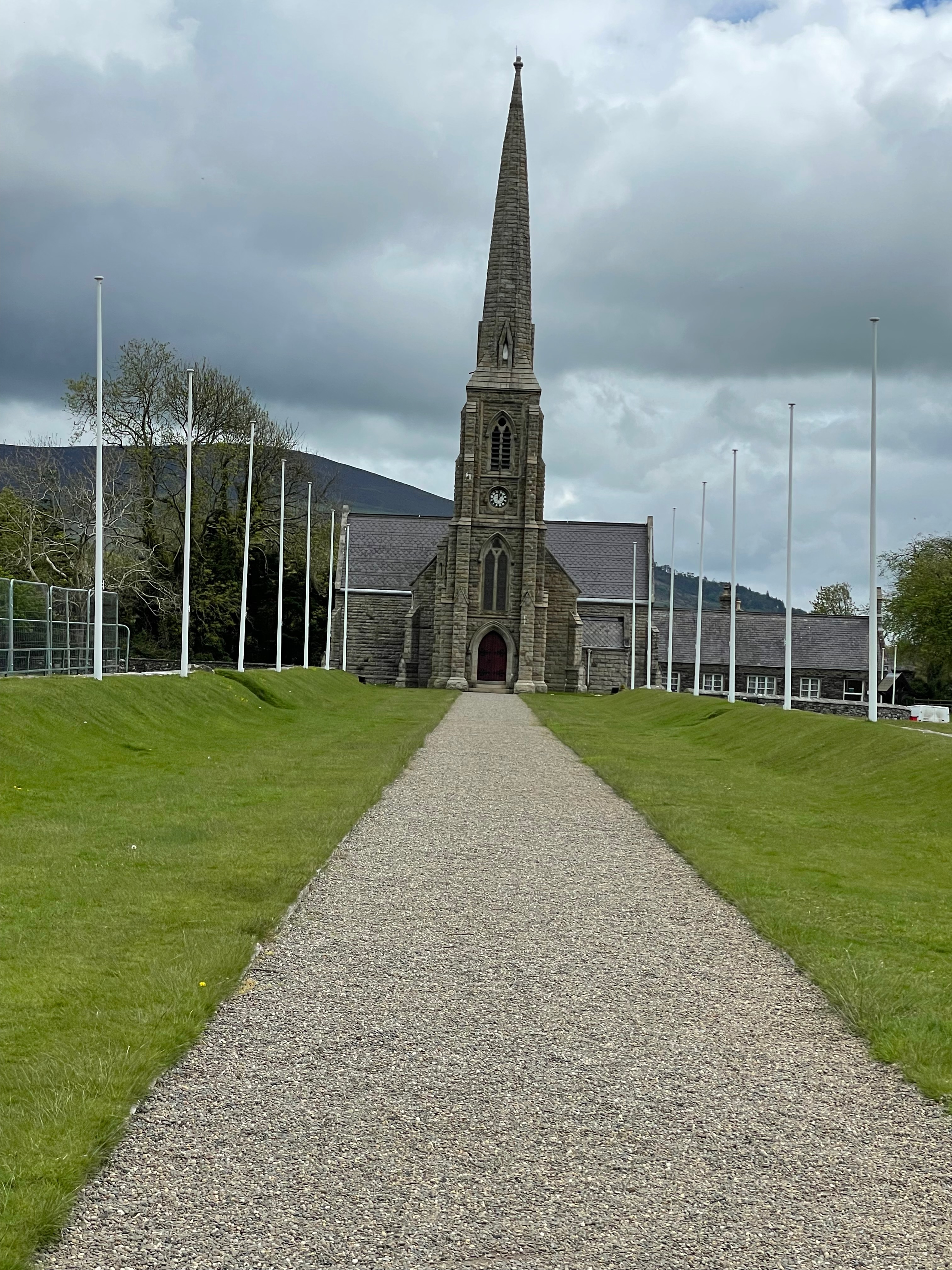
We made a stop at Tynwald  which is where  each year on July 5th Parliament Day is celebrated. There’s a mound there that supposedly was where meetings were held in ancient times and nearby is a church where a service is held first and then a ceremonial procession marches across to the mound.  There are bands playing and the entire population turns out to mark the occasion.

That's the mound which has been terraced


The church from they process on July 5th to the nearby mound


This was a  tender port and the sea was a little rough when we went back to the ship.  There were some people grumbling about the fact there wasn’t a lot to see, but I thought for a little place the residents tried to give us a nice experience. Oh, I forgot to mention that the Isle of Man is the home of Manx cats, the ones with no tails.  Our guide told us there are more Manx cats now in the US than here and that it’s rare to see one.


It was a pleasant, not particularly exciting, day which ended with dinner with a lovely British lady I met a few days ago.  We went to the show which was one I saw on my last cruise on the Quest.  I’m finding it hard not to compare things because everything on that cruise was so good.  These entertainers did a nice job, but I have a special place in my heart for the other group.  And then I went dancing for a little while.


Tomorrow we’ll be in Ireland.  Until then….


Thursday, May 11, 2023

May 10 - A day with Scousers and Beatles

Today was another marvelous day in Liverpool in northwest England.  So, what is a scouser?  That’s the name  often given to Liverpudlians. It came from a stew, scouse, eaten by sailors and working-class people.  This morning I met my friend Hilary who drove down from  her home in the Midlands so we could spend the day together.  We met on our cruise a year ago when we had such a good time, and we’ve stayed in touch.  We were docked at Prince’s Dock and when I walked into the cruise terminal, there was Hilary.


Liverpool is on the river Mersey, which was made famous in the song “Ferry cross the Mersey”  by Gerry and the Pacemakers.  I’m not going into its long history; I’ll only tell you a few things about it.  It was the headquarters of a shipping company called the White Star Line and a ship we’ve all heard of was designed here. Of course, it’s the Titanic.  The Cunard Shipping Line is still based here.  There are other things in Liverpool, but probably the most famous is that it is the birthplace of that small rock band, the Beatles.


Hilary arranged our day and our first stop was the Maritime Museum on the waterfront.  Liverpool had been in decline back around the turn of this century, but then a revitalization program began and the area down at the river is bustling. There are several museums, an arena and promenades.  The Maritime Museum was interesting. It had a lot of information and artifacts about the Titanic and about the Lusitania, another passenger vessel sunk by a German U-Boat in the Irish Sea in 1915 with great loss of life. The sinking of the Lusitania was not the reason the US entered WWI but it did contribute to increased support for our entry since 128 Americans lost their lives.


From the museum we went to the Hard Days' Night Hotel to meet our fabulous tour guide Robbie and his wonderful car, a replica of John Lennon’s Phantom Rolls Royce. For the next few hours Robbie chauffeured us around to the childhood homes of the Beatles and venues mentioned in their songs.  We heard about the early lives of the Fab Four, all of whom came from working-class families. Two of them, Ringo and John didn’t have the best of childhoods. George and Paul came from more stable families.  Paul wanted a guitar but his father instead got him a trumpet.  He then proceeded to pester his dad every day and play the horn particularly badly until his father gave up and got him a guitar. George and Paul knew each other and eventually they teamed up with John Lennon to form a group called the Quarrymen with a couple of other musicians.  The band had moderate success but tried playing under several different names before settling on the Beatles.  

Now this is a ride!


This building was a pub down the street from Ringo's home and was featured on the cover of his 1st solo album.

Paul McCartney's childhood home and where the band would practice while his mum and dad were at work.

Penny Lane of song fame.  It is a street in their neighborhood where the barbershop they sang of still exists.

Midway down you can see Eleanor Rigby's name in the graveyard of St. Peter's Church

The marker outside the church commemorating that this was the place Paul McCartney and John Lennon first played together

The gate to Strawberry Field


I won’t tell you all the twists and turns of their journey to becoming the tremendous success they eventually did.  I can’t remember it all frankly.  I do know that their meeting up with Brian Epstein, who became their manager and who fired their drummer Pete Best because Epstein thought Ringo Starr was better, was the beginning of their trip to fame and fortune. Pete Best, talk about a lost opportunity!

Their boyhood homes were modest at best.  A couple of them had no indoor bathroom facilities, only a tap for running water, and no heating except for coal stoves. Now those houses are visited by thousands of people every year.  We saw Penny Lane and Abbey Road.  We went to the churchyard where Eleanor Rigby is buried and we drove past Strawberry Field, which was actually a large house belonging to a wealthy family who gave it that name. Of course as we rode around in between Robbie’s commentary we listened to Beatles songs.


The ride did also give me a chance to see some of Liverpool and understand a little about the city.  During WWII it was bombed heavily because it was a port and an industrial city. Just a couple of blocks from some of the childhood homes blocks of buildings were bombed.  At that time there weren’t any smart bombs and so residential areas were also destroyed, sometimes purposely and other times by accident.


After we’d gotten more Beatles information than we could possibly remember we were dropped off where we started. Hilary and I had a bite to eat and something to drink at the Slug and Lettuce (strange name) and then went down to the waterfront. We wanted to see the life-size statues of the Fab Four down at the waterfront.  Unfortunately, the Eurovision competition is being held in Liverpool and much of the waterfront area, including the area around the statues is cordoned off and there was a long queue to get near them. We decided we didn’t want to wait and besides it was getting quite cold, not to mention it looked like it might rain any second.  Hilary walked me to the cruise terminal and we said our goodbyes.  It was a fun day and I really appreciated her arranging it all for me.  I’ve met the most wonderful people in my cruising career.


I do have to mention one more thing I did today because it was a first for me.  Despite having sailed about 90 days on this ship and her twin the Encore, I had never eaten in Sushi, the Japanese restaurant on board.  I wasn’t really very hungry so when someone suggested I try it, I thought “why not.”  Am I ever glad I did.  The food was delicious and just enough.  It’s on my list of favorite spots on the ship from now on. After dinner at Sushi I gave myself a night off because there was no show and I was just plain tired.  According to my Apple watch I did close to 15,000 steps today.


Well, that was my “magical mystery tour,” to steal from a Beatles song.  Liverpool is an interesting city and one that I wouldn’t mind coming  back to one day.


Wednesday, May 10, 2023

May 9 - The Last Invasion of Britain

Today was one of those serendipitous days that you can’t ever predict will happen.  I had booked a tour to Carew Castle and Tenby for this morning.  When I got up it was gray and drizzling and the thought of walking through an old castle with slippery, worn stone walkways was unappealing.  I decided to ditch the tour and take the tender ashore and visit the little town of Fishguard, Wales where we landed. It turned out to be a splendid decision.


From the tender there was a shuttle to take us to the center of town.  On the bus there was a charming local man who volunteers to meet us tourists and tell us a little about the place. He was fascinating and the story of the town’s moment in the history books is wonderful so you’re going to hear it all.


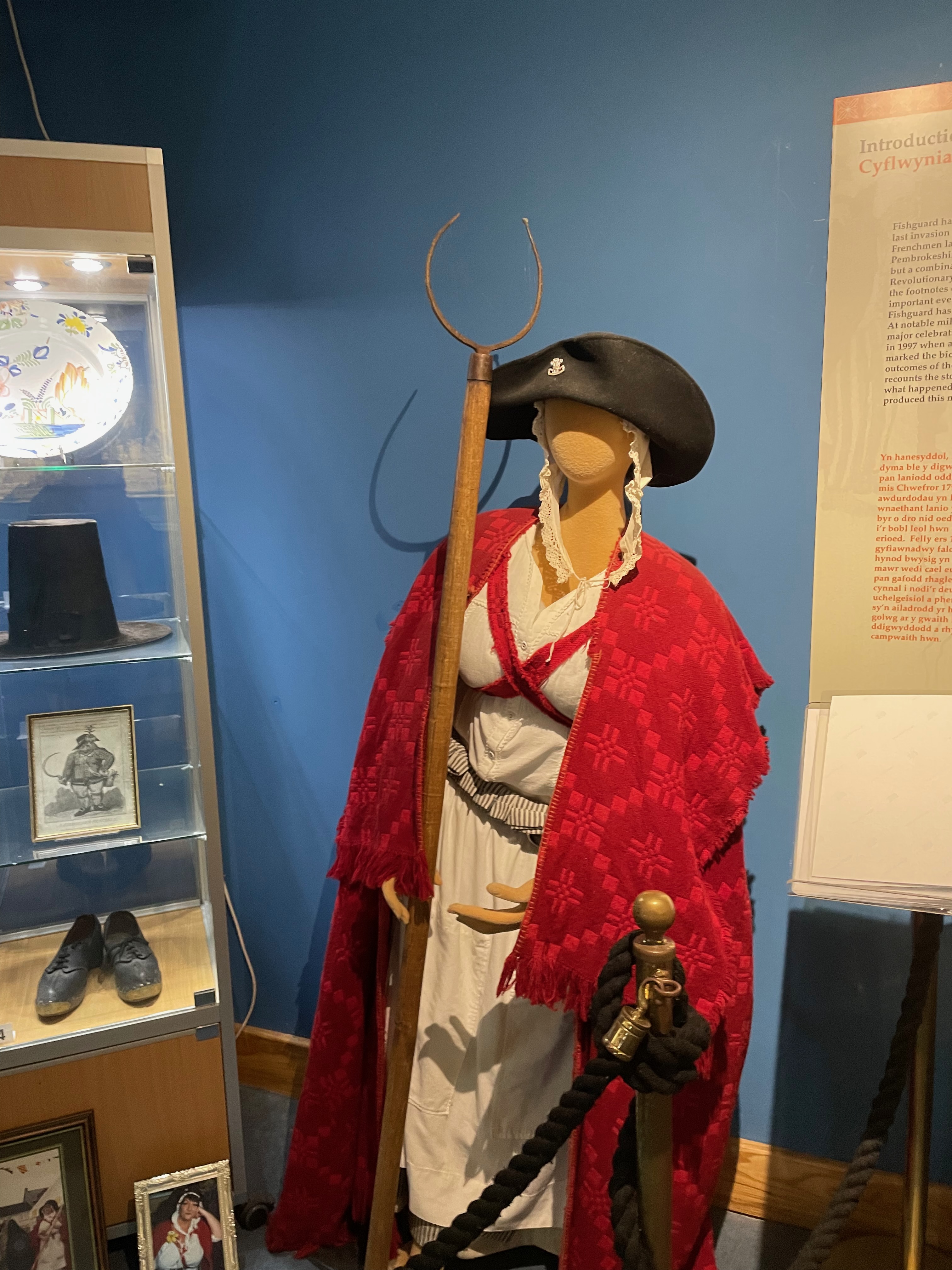
In 1797 the French and British were fighting and Napoleon dispatched warships carrying about 1400 troops to land and capture Bristol (where we docked yesterday). The wind didn’t cooperate with the French fleet and they wound up sailing into Fishguard Bay, our port today. The local fort fired its one and only cannon and cannonball as an alarm to the local townsfolk.  The French thought they were meeting stiff resistance so they withdrew and instead landed at a nearby beach in the village  of LLanwnda (good Welsh name).  The French soldiers were a ragtag bunch of mainly recently released jailbirds (Napoleon had his best troops fighting on the continent).  So, when the French came ashore and began plundering the surrounding town and houses they found lots of food and wine and proceeded to get very drunk. A local woman named Jemima Nicholas, who was a cobbler, came down to see what the furor was about dressed in a red cape and a black top hat carrying a pitchfork. She looked so fearsome to some of the drunken French soldiers that she managed to round up 12 of them and march them off to be locked up in the church in Fishguard.  Then she sent word out to the surrounding farms that the women should dress in their red cloaks and black hats, which happened to be everybody’s Sunday best clothing, and stand on the hills above the beaches.  From the French ships the women looked like British soldiers, or at least their drunken state led them to believe that, so after two days the French surrendered.  In the surrender agreement signed in the Royal Oak Pub in Fishguard, the French commander referred to the "several thousand British troops of the line" coming to meet them in battle.  And so ended the last invasion of Britain in February, 1797.

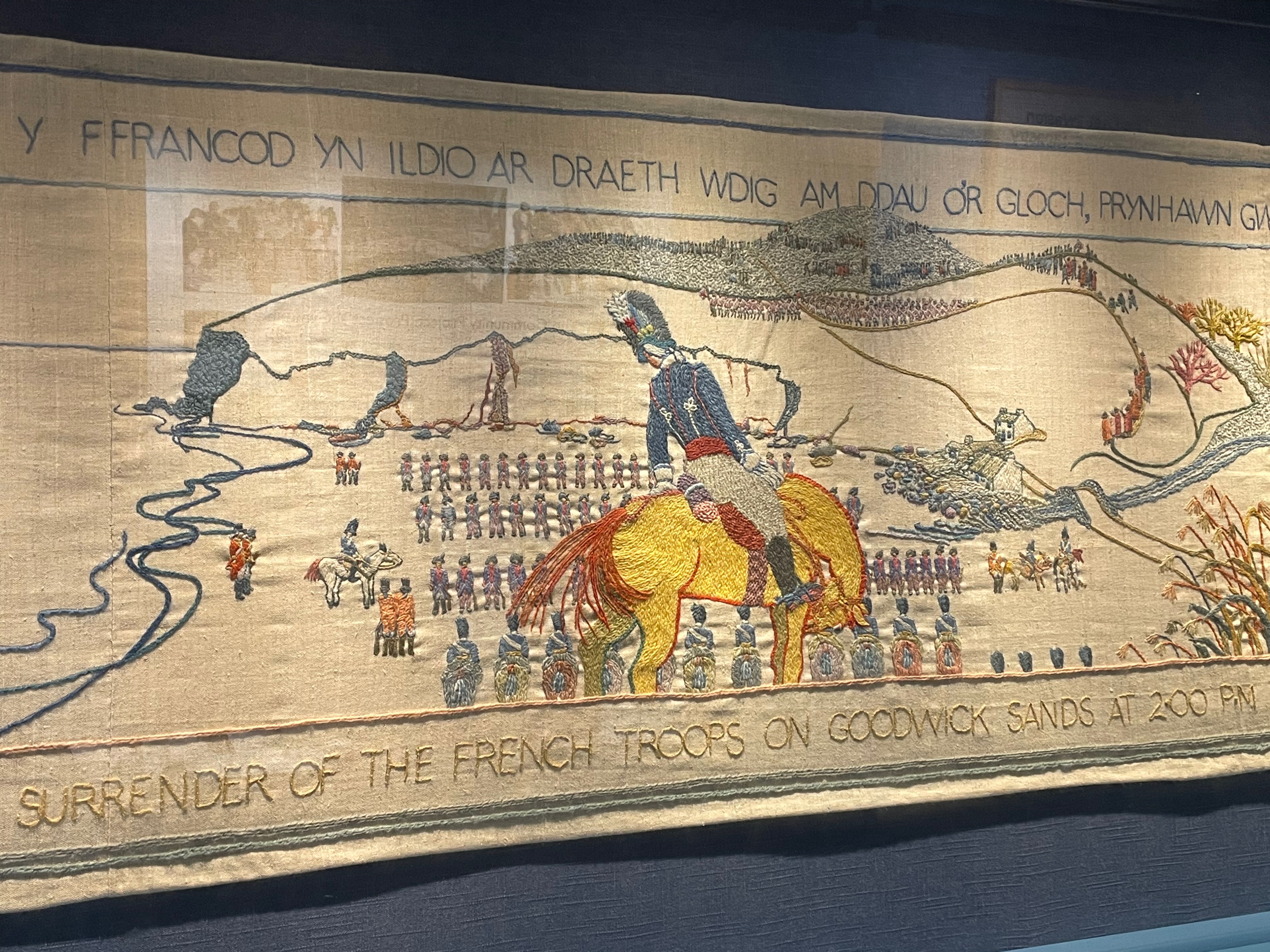
About 15 years before the 200th anniversary of the Battle of Fishguard the townspeople decided to do something to commemorate the event.  They decided to make a tapestry like the Bayeux Tapestry recounting William the Conqueror’s invasion.  Over the next 13 years with the help of an artist who was from the area originally they designed and then stitched a 100-foot tapestry telling the story.  Seventy-three women stitched 41 panels using 154 different colors of threads depicting the events of the invasion.  The pieces were carefully assembled and are on display in the town hall in Fishguard.

A few of the panels of the tapestry.  Look at the detail that these ladies stitched.


Jemima's outfit that threw off the French

Paul, the delightful guide, who told me the whole story next to a plaque with the names of the stitchers


The shuttle bus dropped me off near the town hall and I went up to see this marvel in the second-floor museum.  The guide was a lovely man named Paul and he told me all about it.  I was the only visitor there at the time and he walked along with me as I looked at the beautiful work that had been done.  There was a figure wearing Jemima’s red cloak and hat by the door as well as a portrait of her. They had a marvelous video recounting the creation of the tapestry and the group effort it took.  There were also photos of King Charles, who was then Prince of Wales, and Princess Anne coming for the anniversary celebration.


Across the street is the Royal Oak Pub festooned with British flags and a sign above the doorway declaring it the site of the signing of the peace treaty.  Next to the pub is a monument to the soldiers from Fishguard lost in WWI and WWII with all their names listed and on a wall next to the monument is a wall covered with wreaths of poppies with the logos of local organizations that contribute  to and maintain  the monument.  The British always do a marvelous job remembering the men they lost fighting for Britain and the phrase "lest we forget" is etched in their souls.  Close by was the St. Mary's, the church in which Jemima locked up the French soldiers. It was small but very pretty and I liked the dark wood. The stained glass windows were newer than the church and commemorated the Battle of Fishguard.

The Town Hall where the tapestry is housed

The Royal Oak Pub where the French surrendered

Memorial to those who perished in the two world wars

St. Mary's Church


The town was quaint and the people were delightful.  I sat on a wall waiting for the shuttle after my walkabout.  An elderly lady came along with a bag with some groceries on her way home from shopping.  She sat down next to me and we had a lovely chat about the coronation and her life in Fishguard and mine in Virginia.  After a while she said she needed to go and told me she had just bought some thick pork chops and was going home to cook them along with some "Pembrokeshire new potatoes and runner beans" she had put up last fall.  

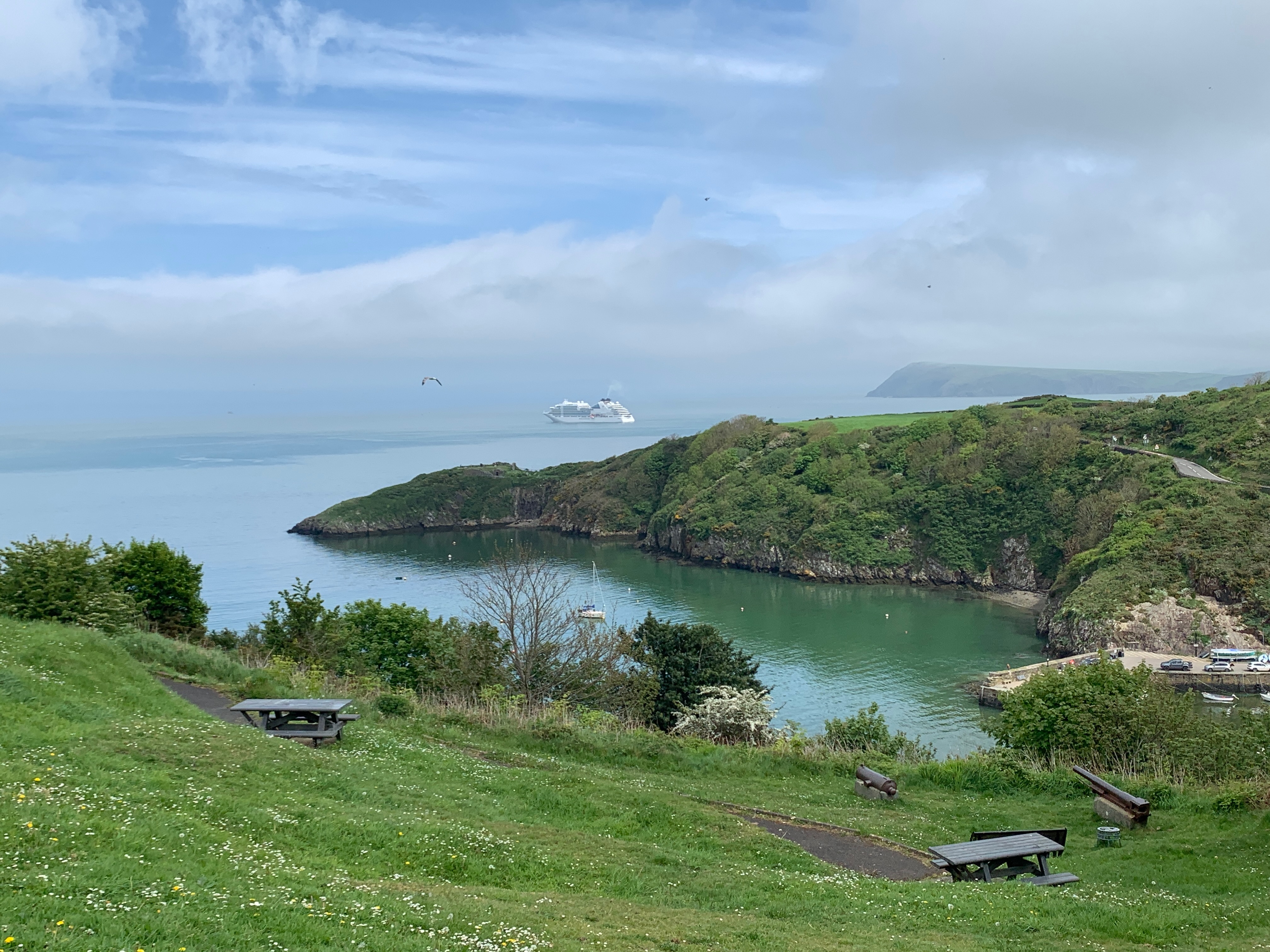
These are two views from the town.  The first is a little fishing village below and thee second is a view of the bay and our ship in the mid-distance. Can you tell I fell in love with this place?


I missed seeing a castle but I think my day was much better having heard the story from Paul and chatting about life in this little welsh town with the nice lady whose name happened to be Anna.  


Tuesday, May 9, 2023

May 8 - Bath, Somerset, England

We docked this morning in the port for the city of Bristol.  It was cloudy, not too chilly, and the sky looked pretty ominous.  I had a tour to Bath which didn’t leave until 1:30 so I tried to catch-up on some e-mails and things I needed to attend to.


We boarded the bus and were off for the roughly one-hour ride to the city of Bath. Bristol itself is a very industrial city. For example more than 650,000 new vehicles pass through there each year.  There are also lots of tech businesses located there.  During WWII the city was bombed and as a result most of the buildings are post-war era.


Bristol lies at the mouth of the river Avon; no, it’s not the one where Shakespeare came from.  The word “avon” comes from the welsh word “afon” which means river. There are 8 or 9 Avon Rivers here in the UK, literally meaning River River.  Strange .This particular Avon River has a tidal difference of 49 feet, second only to the tidal variation in the Bay of Fundy in Canada.


We followed the course of the river inland through lush countryside with occasional sheep and cattle grazing along the way.  It was beautiful even under gray skies.  The city of Bath with a population of around 110,000 has been inhabited since the Stone age.  The thermal springs may have been worshipped by the ancient Britons before the Romans arrived on the island.  Archaeological evidence showed that the springs were identified with the goddess Sulis, who the Romans called Minerva.  The Roman name of the town was Aquae Sulis, the waters of Sulis. 


Our first stop was the Royal Crescent, literally a crescent shaped building consisting of 30 row houses, each five stories tall, built in the 1760’s in the Georgian style. The baths with their hot springs had become popular during the reign of Queen Anne and so the  wealthy came to enjoy the waters.  The building stands at the top of a little hill with a park spreading out below it. Today, one end of the crescent is a museum; the middle couple of houses are a hotel and the others have mostly been turned into apartments. There are still a couple of single-family units which sell for about £ 8 million.  A flat can sell for £800,000.  I don’t see one of them in my future.


We next drove to downtown Bath passing along the way the Jane Austen house. That author set several of her books in Bath.  Mr. Darcy was standing out front greeting people.  We also passed Bath’s version of the Ponte Vecchio in Florence, a bridge across the Avon with stores across its span.

That's Mr. Darcy in the top hat


A pretty little park in the center of town


After getting off the bus we walked through some quaint little streets on our way to Bath Abbey. Along one of the streets there was a bake shop in the oldest house in Bath, Sally Lunn’s house, built in 1482 and where Sally Lunn lived in 1680.  That name should ring a bell if you’ve ever eaten in a Colonial Williamsburg tavern or looked at a CW cookbook.


Bath Abbey, properly named the Abbey Church of Saint Peter and Saint Paul, was founded in the 7th century, reorganized in the 10th, and rebuilt in the 12th and 16th centuries.  Major restoration was done in the mid 19th century. In other words, it’s very old. Something I found very interesting was the memorials in the church. There are 617 wall memorials and 847 floor stones commemorating people who I assume were members of the church. The building has fan vaulted ceilings similar to those in the Henry VII chapel in Westminster Abbey.

Kind of a cock-eyed shot of the church taken from the bus

The fan vaulted ceiling

Main Altar

The organ

Wall memorials

I liked the inscription on this memorial "The Ingenous Mr. Harvey"


After our brief visit and because we had some time a friend and I went into a glass shop in the square next to the church.  A type of glass called Bristol glass is something supposedly unique to this area.  In the glass shop we talked with a very knowledgeable man who turned out to be a glass artisan.  He explained that the different colors result from the different minerals put into the sand when glass is prepared for blowing.  I found a couple of pieces that I liked (small enough to carry home) and found that one was actually made by the man we were talking to so I had him sign the certificate of authenticity.


We still had a little time before the group had to meet to move on to the Roman Bath so we sat at an outdoor cafĂ© and had some hot tea and people-watched, one of my very favorite pastimes. I saw one woman I had to take a picture of because her hair and outfit were so jarring that she stood out like a sore thumb.  Why would someone do this to one’s hair?


Our last stop for the afternoon was the Roman Bath. The source of the thermal springs is rainwater which falls in the nearby Mendip Hills.  It seeps into the ground to a depth between 9,000 and 14,000 feet where  geothermal energy raises the temperature of the water to between 150° and 200° degrees.  The hot water which is then under pressure bubbles up through fissures in the limestone on which the city is built and eventually comes out in the baths.  A temple was built on the spot between 60 and 70 AD and as a settlement grew around the temple the baths were constructed.  They were in use until the end of Roman rule in England in the 5th century. For a period of time the baths fell into disrepair but in the middle ages they were rebuilt.  They are no longer in use because in 1978 a young girl died of a deadly disease caused by a pathogen found in the water.  Now the baths are just a tourist attraction. On the lower level where people entered the waters, I encountered a Roman, a historical interpreter like the ones we have in Williamsburg.  I couldn’t resist having a picture taken with him.

Looking down at the baths


The hot spring bubbling up must have lots of iron in it 

The Roman I met along the way


Then it was time to gather the group together and head back on the bus to Bristol.  Just before we made it to the bus rain began in earnest, but I didn’t get too wet.


Tonight I had dinner with 3 other ladies at the Thomas Keller Grill and I went to  the pianist’s concert. He was as good the second time around as the first.  Afterwards I went to the Club for a little while, and there were dancers.  I managed to tire myself out (a good thing) and then went home to my cabin.  I may not get this posted until tomorrow, but at least it will be written