Wednesday, May 15, 2019

May 15 - Another day in the Gulf of Aden

Here we are still in the Gulf of Aden.  Hot, sunny and muggy are the operative words today.  At noon we were about 55 miles off the coast of Yemen on our starboard side and a little further offshore from Somalia on our port.  When I look at the Marine Traffic website I can see that all the shipping is traveling in the same traffic lane with no one venturing closer to either shore.

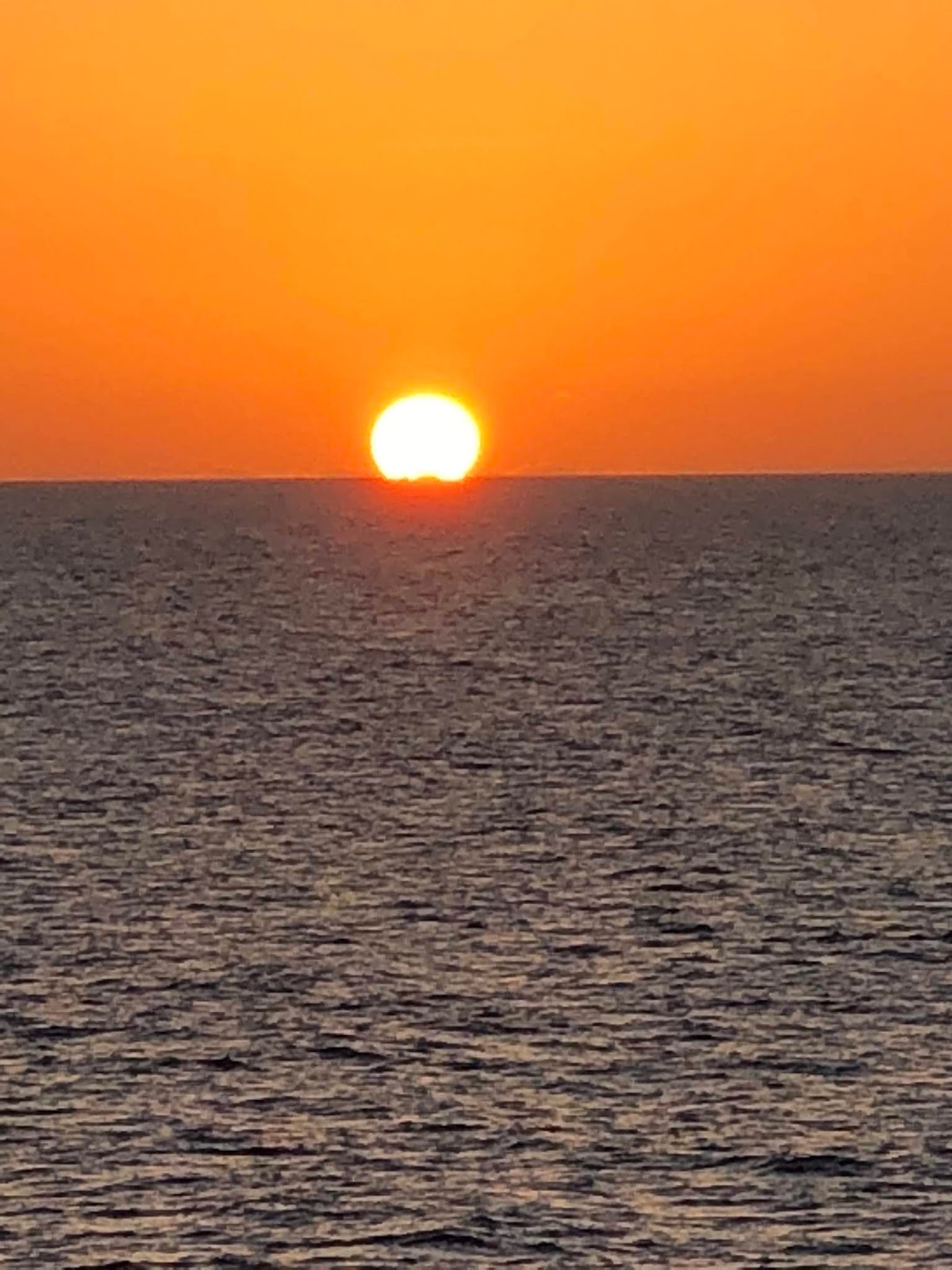
Last night we had quite a lovely sunset.  The colors on the water and in the sky were beautiful!  Monet would have loved it.

Today we have the usual lectures, games and classes.  We may become a lot better educated after all these sea days.  Unfortunately our trivia team didn't fare so well.  We'll have to study harder in order to make up ground.  Scores are cumulative so there's still hope.

I wandered around the ship this morning taking some pictures of different public areas. It is really a beautiful ship and I think the lounges and restaurants are nicer than on the smaller Seabourn vessels.  Alice, these aren't the best photos but they should give you some sense of how Encore is different from the Quest.

Entrance to the main dining room

Main dining room

Seabourn Square where guest services, the shops, and the coffee bar are located
The coffee bar, a sort of Starbucks at sea where you can get coffees, wine, snacks and gelato all day and all included

The bar at the Thomas Keller Grill where a pianist plays in the evenings

The Thomas Keller Grill, one of the other dining venues.  There's also a sushi restaurant and the Colonnade, the informal restaurant for breakfast, lunch and dinner but they were both closed during my walkabout

Observation Bar at the top of the ship all the way forward.  There's live entertainment there at night too.

Tuesday, May 14, 2019

May 14 - At Sea somewhere in the Gulf of Aden


Here we are on another hot, sunny day moving along at 17 knots through the Gulf of Aden. We have been blessed with very calm seas; in fact, we would enjoy just a little motion but many people don’t so it’s  better for them.  On our starboard side we are roughly off the border between Oman and Yemen.  On the port side we are approaching the Horn of Africa and the lovely country of Somalia.  When I look out from our veranda I see not a single ship nor speck of land.  I know there are other ships nearby because on the Marine Traffic website I can see them.

Yesterday evening at 6 PM we had a Block Party.  People step out into the corridor and meet their neighbors.  Staff members come around with champagne and canapés and the Captain and some of his officers pass through the corridors greeting everyone.  It’s perhaps a little cheesy but you do get to meet your next-door neighbor. 

Today we don’t have lot planned.  At noon it’s time for trivia.  This afternoon we’re going to a lecture about Iran.  Seabourn does a nice job having lecturers on relevant subjects.  This afternoon’s speaker is a specialist in Middle Eastern affairs, especially religion.  When we did this cruise in the reverse several years ago one of the speakers was Tony Mendes.  If any of you saw the movie Argo, he was the man who formulated the plan and brought the 6 US diplomats out of Tehran when the embassy was overrun.

There’s not a lot to report about on lazy sea days, so I thought I’d mention a little more about Omani culture.  The average Omani family has five children.  Compare that to western societies which for the most part have less than two.  The  status of foreign workers is very poor.  Essentially they have no rights and are paid subsistence level salaries at best.  Oman was one of the last countries to abolish slavery in 1970.  Despite abolishing it there are still some 25,000 slaves in the country.  If an Omani wants to marry a foreigner, he must get permission from the government.  If he doesn’t he can be thrown in jail.  In other words, many of the things we take for granted are unheard of in countries like Oman and other places in this part of the world.

We had lunch with some of our trivia teammates today, a lovely couple from New Zealand. Ken told us that  he has seen several young, very fit men dressed in the same black jeans and shirts about on the open decks so we have in all probability picked up some extra security people  for our transit through these waters. They aren’t obvious but it’s nice knowing they are around.

That’s about all for today.  Tomorrow I’ll try to wander around taking some photos of the ship.  It’s quite an elegant vessel; I think I like the décor better than the smaller ones we’ve been on before.


Monday, May 13, 2019

May 12 - Muscat, Oman

-->

Today we’re in Muscat, Oman.  This is the capital of the Sultanate of Oman, a country situated on the southeastern coast of the Arabian Peninsula. Its borders are shared with the UAE to the northwest, Saudi Arabia to the west and Yemen to the southwest.  Oman is an absolute monarchy ruled by Sultan Qaboos bin Said al Said who has been the ruler since 1970.  His family has ruled the area since the 1740’s.

Oman was historically an important trading hub along the trade routes to India and the rest of Asia.  The British recognized this and formed a mutually beneficial relationship to protect their interests.  As with other countries in this region, oil and natural gas were found and form an important part of the economy.  Oman doesn’t have as large reserves as some of the other Middle Eastern countries so it is trying to build its tourism business.

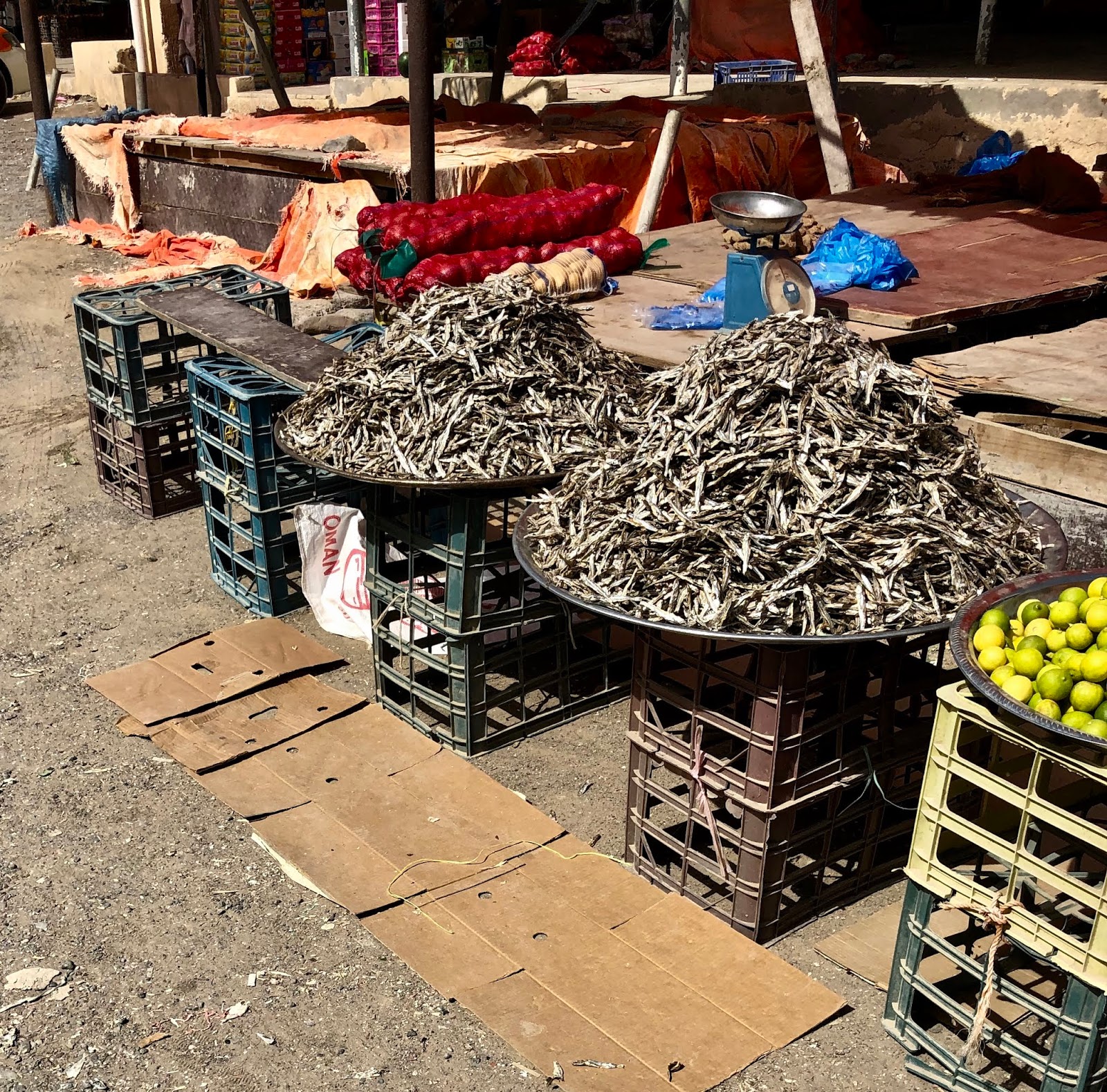
We decided to take a tour to some places outside of the city.  Our first stop was a place called Barkha, a traditional fishing and market town.  Along the way we passed lots of desert with little scrubby acacia trees.  In many of the areas we saw camels wandering, munching on the shrubs, as well as sheep and goats.  The camels are not wild; they all belong to someone  our guide Hussein told us. Back to Barkha.  We stopped to visit the fish and vegetable market.  There was no such thing as refrigeration and the fish just lay out in the open. It was frankly very unappetizing. There was haggling going on over prices.  The vegetables looked much better. I found it interesting that I saw not a single local woman there.  The vendors, buyers, and hagglers were all men.
Filet of fish for lunch anyone?
Notice the refrigeration (or lack thereof)
Dried sardines, one of the main catches around these parts

This nice vegetable vendor let me photograph him.
Our next stop was the An Naman Castle, one of the 500 forts, castles and watchtowers in Oman.  This particular one is thought to have been built around 1691.  We only went into the ground floor because the stairs up were steep and spiraling, not good for knees and backs.   The number of forts is astounding.  It seemed on every mountaintop and all along the coast there are towers and forts.  I guess they were keeping away pirates and other marauders.  From An Naman we drove to the Nakhl Spring and oasis.  By comparison to the rest of the countryside this area was positively lush.  The spring cascades out of the mountain and travels down the hillside.  Along the way little canals have been built to channel the water to different houses and gardens .  Mind you, this isn’t an alpine stream we’re talking about, but for this desert country it’s unusual.
An Naman Castle
Another castle on the way to the oasis
A desert spring bubbling out of the rock
 
An oasis in the desert
After visiting the spring we had lunch at a nearby resort.  To enter the property we passed through a gate topped with concertina wire.  They are obviously serious about only letting in paying guests.  Lunch was an eclectic buffet of  Arabian, Indian and southeast asian dishes.  Despite the fact that it’s Ramadan, our guide Hussein and driver Hassan had lunch.  I’m glad they did; it would be dreadful for all of us to eat and drink while they had to wait and continue their fast until sunset.

Our last stop was just a photo stop at the Grand Mosque in Muscat.  It is very large and quite beautiful.  However, having just seen the Shekh Zayed Mosque in Abu Dhabi, I have to say that the one in Abu Dhabi was my favorite.
Grand Mosque in Muscat

Back at the port  there were a few interesting things to watch before we sailed.  The Sultan has two very large yachts docked there.  We estimate the larger to be at least 300 ft. long.  There was an Italian navy frigate tied up near us. We suppose he’s part of the international naval forces that patrol these waters to discourage piracy.  The most interesting thing though was a dhow loaded with watermelons.  As we watched, lots of little trucks pulled up on the dock next to the dhow and men began unloading the watermelons one by one and by hand. The men formed lines from onboard to the dock and they tossed the watermelons along to the next in line and into the waiting trucks.  At one point they had unloaded most of them from one side and the dhow had a serious list.  When we left they were almost finished tossing what must have been thousands of melons.

Not another cruise ship, just the Sultan's yacht
Dhow full of watermelons

If you look at the cabin on the aft of the dhow you can see how it's listing to port as they've unloaded melons from one side.

Three watchtowers and a fort just on the little piece of coast we sailed past on our way out of Muscat

So now we're off for 6 days at sea sailing through the Arabian Sea and the Gulf of Aden before entering the Red Sea.

Sunday, May 12, 2019

May 11 - Strait of Hormuz


It’s a sunny, muggy day here on the Encore as we make our way from the Persian Gulf to the Gulf of Oman via the Strait of Hormuz.  I think a little information about these bodies of water is in order.  The Persian Gulf  is essentially an arm of the Indian Ocean with its only entrance being through the Strait of Hormuz.  It is bordered to the northeast by Iran and along the south by the Arabian Peninsula.  The Gulf is relatively shallow with its mean depth only being about 165 feet.  This is a major shipping area for oil and natural gas tankers carrying their loads from the oil rich countries around the Gulf.

The Strait of Hormuz is a choke point allowing all the tankers to exit to the rest of the world. About 20% of the world’s petroleum must pass through the strait making maintaining open passage a very important international strategic interest.  At its narrowest point the strait is only 21 nautical miles wide.  To avoid collisions ships follow a Traffic Separation Scheme.  There are inbound and outbound lanes, each two miles wide, with a two mile “median” in the middle.  During the transit ships are passing through the territorial waters of Iran and Oman and do so under the provisions of the UN Convention on the Law of the Seas.  According to the US Energy Information Agency in 2011 an average of 14 tankers a day passed through the Strait carrying 17,000,000 barrels of oil mainly to countries in Asia.  With those kinds of numbers it’s easy to see why the occasional saber-rattling  and threats to close the waterway by Iran have global implications.
 
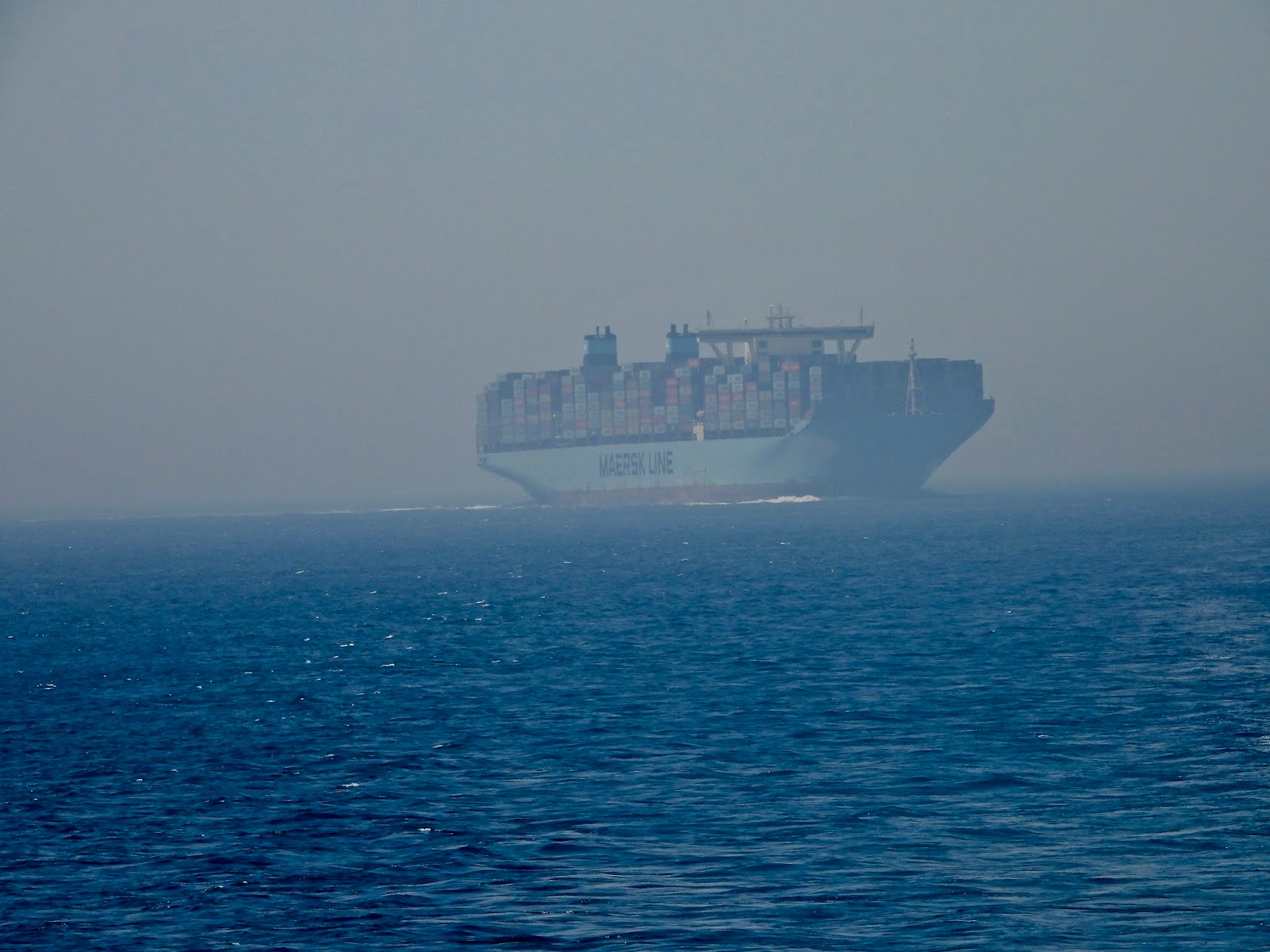
This big container ship was headed in to the Gulf.
Two of the many rocky islands in the Strait.  That's why everyone has to stay in their lane!

We’re making an uneventful transit with the excitement for the morning being the crew drill which just concluded.  Once we leave Muscat, Oman tomorrow evening we’ll round the end of the Arabian Peninsula and head westward through waters that have sometimes seen a lot of pirate activity.  The crew drilled for that this morning.  There were announcements that two small, swift boats were approaching our stern.  The crew decked out in helmets manned water cannon.  They simulated repelling boarders.  The last time we traveled through those waters we actually picked up some armed security who stayed with us to our next port.  I don’t know if the same thing will happen when we depart Muscat.  We shall see.
In the middle there's a crewman decked out in his helmet manning his gazillion watt light
One of the water cannons spraying the sea beside us


Here’s a little anecdotal story about a Seabourn ship.  About 8 years ago one of the company’s original little ships was sailing in the waters we’re headed to when a small boat of pirates approached.  The ship sped up and wasn’t boarded but the pirates did manage to fire some RPGs, one of which didn’t explode but did penetrate into someone’s cabin.  That would get my attention and it must have made for a great story to tell around the campfire for those passengers.

After a lovely dinner we went to bed because we had an early morning wake-up call for our tour in Oman.  More later.

Friday, May 10, 2019

May 10 - Sir Bani Yas Island

-->

Today was essentially a beach day.  We are holding position of Sir Bani Yas Island which is the largest natural island  of the United Arab Emirates.  It’s roughly 10 miles by 5 miles  in area.  The name originates from the Bani Yas tribe who were the first inhabitants of Abu Dhabi. Sir Bani Yas means the crest of a salt dome.  In 1977 Sheikh Zayed bin Sultan established the island as a wildlife reserve. Because of careful maintenance for four decades it is now the home of thousands of free-roaming animals and  millions of trees and plants in a variety of species.
 
Seabourn Encore holding off Sir Bani Yas
There are some permanent pavilions along the shore for ships to use for picnics and sunbathing.  This morning the staff began tendering over food, beverages, plates and cutlery so we passengers could have a barbecue under the fixed canopies.  In addition, some of the staff went in the water with surfboards from which they served caviar in the surf, a signature Seabourn event.
Lunch under a pavilion

We tendered over around 11:30 AM.  There was a short walk to the covered pavilions where dining tables had been set up.  Further ashore was an area with lots of umbrellas made of palm fronds with lounge chairs beneath them.  We aren’t beach people anymore so we stayed in the pavilions. 
Palm umbrellas for the beachgoers

I did walk over to where the caviar in the surf was to be served.  It was hotter than blazes!  At 11:45 one of the zodiacs from the ship came roaring along the beach with a siren sounding to let people know that caviar was being served.  We didn’t go in to get any.  The sea bottom looked rocky and full of shells.  Considering we can order caviar and champagne anytime we like onboard (another Seabourn signature thing), it just wasn’t worth it.
 
The caviar is coming! The caviar is coming! It's time for caviar in the surf.
People lining up to get their caviar

The buffet barbecue then began.  There were the usual BBQ items like hot dogs, hamburgers and ribs with the addition of grilled lobster, which was yummy!  They had a large assortment of salads, chips and salsa, desserts  and even homemade gelato.  It was a neat idea but after lunch we went back to the ship to be back in a/c.

Tomorrow is a sea day as we proceed out of the Persian Gulf and through the Strait of Hormuz.


May 9 - Doha, Qatar

-->

Doha is the capital and largest city (approximately 2,000,000) of the State of Qatar.  This is another city whose growth was propelled by the discovery of petroleum and natural gas in its territory.  While it has large oil reserves, its biggest holdings are in natural gas.  Qatar has the third largest proven reserves of natural gas in the world.  As with Dubai, that industry has fueled the creation of a modern metropolis out of what was desert at the edge of the Persian Gulf.  Also like Dubai, Doha is becoming a financial and trade hub.

We arrived around 7 AM in the midst of a sand storm.  This sand storm isn’t like the ones you see in movies with swirling winds and brown sand everywhere.  Instead the air is full of a fine white grit which makes it look like a really hazy day.  After breakfast we took the shuttle bus into town since we had no tour booked today.  Our choices were 4X4ing in the sand dunes or a dhow ride and snorkel, neither of which sounded like our cup of tea.
Doha through the sandy haze

As we were entering the cruise terminal to get to the shuttle we encountered a man in traditional Arab attire with a beautiful falcon on his gloved hand.  Falconry is something these people have practiced since as early as 3500 BC.  The Bedouins would capture migrating falcons and train them to hunt for them in the desert.  In the spring they would release the birds unharmed so they wouldn’t die in the brutal summer heat.  Today falconry is a sport not done for hunting.  During our trip to Abu Dhabi the other day we passed a falcon hospital which is world renowned and run by an Englishwoman.  Ute our guide told us that falcons are so highly prized that when someone travels with one it is not caged but rather it is hooded and a seat on the plane is purchased for it.  Anyway, the falcon we saw was a beautiful female.
Ignore the person on the left and just look at the pretty girl in the middle


Doha will be the site of the 2022 FIFA World Cup (soccer ).  The port is undergoing major construction because we’ve heard that many soccer fans will be staying on cruise ships as there aren’t enough hotels here.  From what we could see, Qatar will have its work cut out to complete their preparations.  Anyway, what we could see from the shuttle was unimpressive.  The bus stopped at a large modern mall which looked very much like the malls in Dubai.  Surrounding the mall were skyscrapers.  There was nothing that looked like a tourist sight worth seeing and since we weren’t in the market for shopping in Gucci or Armani, we made the return trip to the ship. The fine grit was also wreaking havoc with our eyes and sinuses.  I wonder how people who live here deal with it.  All the construction workers in the port area were wearing bandanas over their noses and mouths.  I guess that's what you have to do.  Tomorrow we'll be at Sir Bani Yas Island.

Thursday, May 9, 2019

May 8 - Boarding day and the start of the cruise!

-->
The driver sent by Seabourn to pick us up arrived early.  We checked out of the Oberoi, loaded up the luggage and we were off.  To get to the marine terminal we passed through an older, less tourist and financial part of town.  Here the streets weren’t lined with massive skyscrapers.   Eventually we arrived at the port area.  There were vast parking lots filled with rows and rows of various vehicles, all identical, waiting to be shipped someplace.
Cars, cars, and more cars going somewhere

As with everything else in Dubai the terminal was built to impress. It has marble floors and was very large.  Our luggage was dropped off and then we were told to wait.  There was lots of seating and Seabourn had a table set up with water, cold towels, rum punch and champagne.  Around noon it was time to board.  It took only a few moments to check in and we walked onboard.  Our cabin was ready so we dropped our carry on bags off before heading to lunch in the Colonnade.
A view of the terminal

We are once again in a Wintergarden Suite.  I think it’s nicer than the ones on Seabourn’s smaller ships.  I’m certain it’s a little larger and the furnishings seem more comfortable.  I’m posting a few photos; we’re going to be really spoiled!
Our living room

Dining area

Bedroom

Main bath walk-in shower
The rest of the main bathroom
Sunsetting on the Burj Khalifa as we prepare to sail. That's the old Queen Elizabeth in the foreground. She's now a floating hotel.