Sunday, September 16, 2012

September 14 - Venice


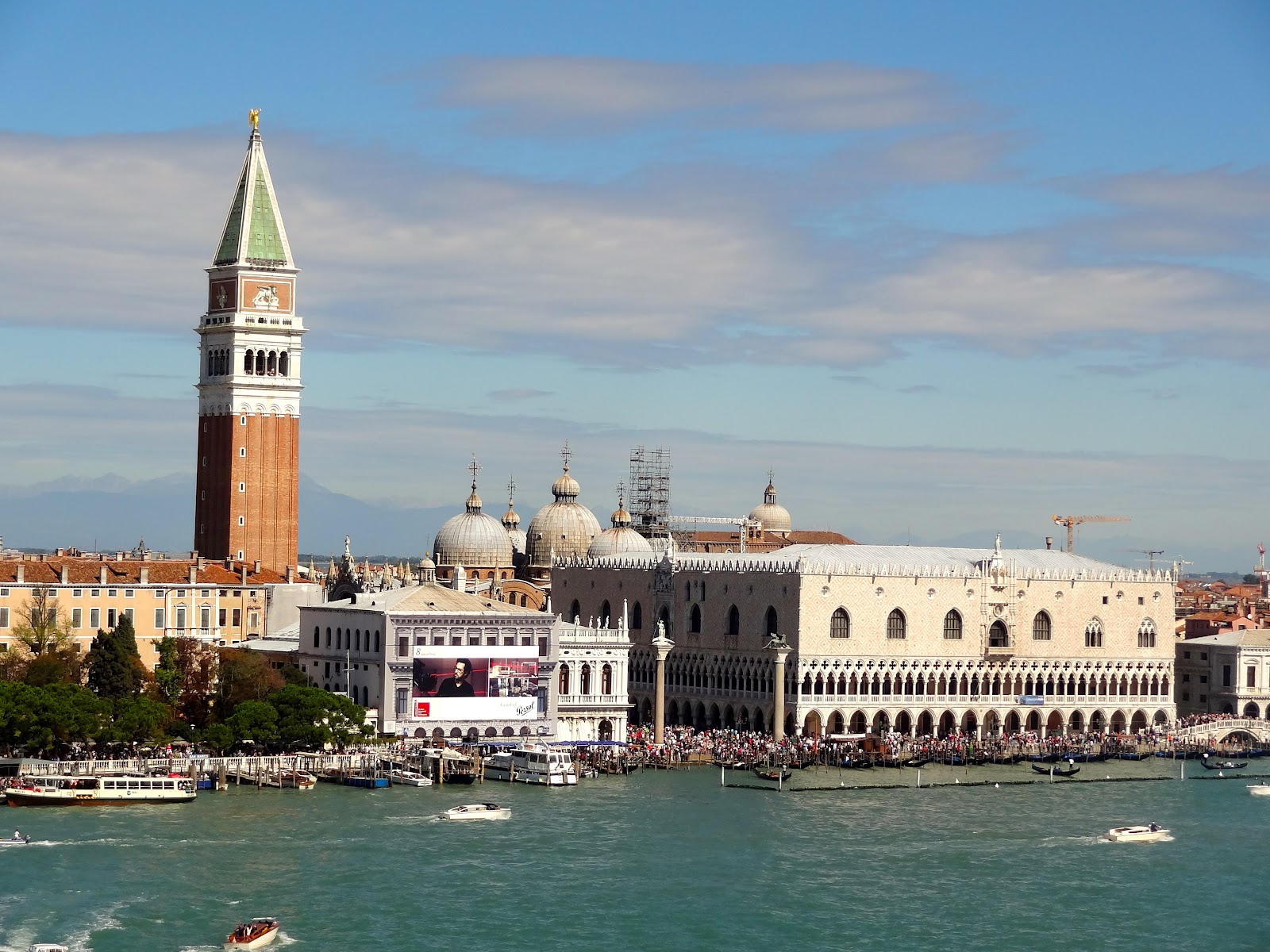
After another much needed sea day yesterday  we arrived around midday in Venice.  Overnight we must have passed through a front in the Adriatic because during the night we had some big bumps and a few little things fell over.  But this morning as we sailed through the Moses Project into the lagoon the air was wonderfully clear and the temperature was in the high 70’s.

A picture perfect day to sail into Venice


After the ship was cleared we went ashore and walked to the People Mover.  The ship was tied up at the furthest dock from it, so it is a pretty decent walk there.  From Piazzale Roma we bought our vaporetto tickets and took the boat to the Rialto Bridge.  We had decided to eat lunch at one of the restaurants we like, the Barababao, which is not far from the bridge.  We had a really nice meal and a house wine.  As we ate,  Al  noticed that the waiter kept looking at him strangely.  When we paid our bill, the waiter said, “You have a twin in Venice.”  Evidently there is a mathematics professor who looks just like Al and the waiters were confused at first.

Our next stop was Murano.  We wanted to go to the glass factory where we’d previously bought some things.  Per haps we shouldn’t have gone there, but we did find a bowl that will look really nice on the dining room table. It was getting late in the afternoon and we were getting tired so it was back to Venice proper for us.  We got a little lost on our way back to the Rialto area, but eventually found our way.  We stopped for some gelato (at one of the places that Katie and I had found in July) and we bought some wine at the shop we like near the bridge. Then it was back to the ship for our last night aboard.

It was such a nice evening that after a small bite to eat at the buffet, we brought a bottle of wine back to our cabin and sat on the balcony enjoying the breeze and the view.  It was a nice day and a nice end to the cruise.  Tomorrow it’s back to London for a couple of nights before our return home on Monday.

A five-masted tall ship we saw in the early morning as we ate breakfast on the balcony just before disembarkation

Saturday, September 15, 2012

September 12 - Athens


September 12  - Athens

Another early morning!  We arrived in Piraeus, the port for Athens at 4:45 AM.  Thankfully we got to sleep a little later.  By 7:30 we were off and on our way.  First stop was the Acropolis Museum completed in 2009 and very close to the foot of the Acropolis.  Many of the marble sculptures (known as the Elgin Marbles) have wound up in the British Museum in London.  Greece built the Acropolis Museum hoping to convince other countries that had some of their antiquities to return them to a suitable repository.  There is some disagreement about how the marbles wound up in London.  On the one hand the Greeks believe them to have been stolen.  On the other hand in the British Museum there is on display a copy of the letter from the Ottoman Sultan who controlled Greece at the time giving permission to take the marbles.  It’s difficult to know who’s right.

In any event the Acropolis Museum is a state of the art and magnificent place with many artifacts found on the Acropolis.  There are a number of to scale replicas which give you the idea of what was originally there.  It also is built atop ruins of the ancient city.  To preserve those the museum was constructed on pilings above the ruins and one can look down through glass floors at them.  They are being excavated and studied today ( we saw some archaeologists working).

Ruins beneath the Acropolis Museum
The new Acropolis Museum as seen from the Acropolis - a stunning contrast between ancient and modern


Our next stop was the Acropolis and Parthenon.  What a difference 2 months make! When I visited with Katie in July the temperature was 108°.  Today it was closer to 85°.   We began our ascent with our guide Maria stopping along the way to give us information about the place.  The Acropolis was originally a fortress to which women, children and old people could retreat when the city was under attack.  It rises some 500 feet above the city with a commanding view of the surrounding area.  Even today there are no high-rise buildings to block the view of the sea from the Acropolis.

The Parthenon  is a temple honoring the goddess Athena who is the patron of Athens. In mythology Poseidon, the god of the sea, and Athena, the goddess of wisdom, competed for the naming rights to the city.  Poseidon struck his triton down and a fountain of water sprang forth.  Athena produced an olive branch from which she said olive trees would grow.  The Greeks chose Athena and olives.  (As an aside today some 500 varieties of olives grow in the country.)  Anyway, the Parthenon’s construction to honor her was begun in 447 BC and completed in 439 BC, although decoration continued to 432 BC.  The building is immense with a base of nearly 230 feet and width of more than 100 ft.  Interestingly, though it appears otherwise, there are no straight lines in the building.  The base and columns all have some curvature that is only visible from a few points at the corners.  Were the columns to be extended upwards they would form a massive pyramid.  It is truly remarkable to think of the construction of such an edifice in such a short time period.

Al by the Parthenon
The theater at the foot of the Acropolis - concerts are held there to this day


During the control of the Ottoman Empire at one point the Parthenon was used as an ammunition storage facility.  While at war with the Ottomans, the Venetians bombarded the place and caused a massive explosion destroying much of the building.  Today restoration is going on but it will soon be over.  In order to maintain some historic integrity, no more than 10% will be replaced.

On the north side of the Acropolis is the Erectheion, which was a  temple honoring Athena.  This temple is notable for its Porch of the Caryatids or the Porch of the Maidens.  It has six female figures instead of traditional columns supporting the weight of the porch roof.  Between the Erectheion and the Parthenon are remnants of the older or pre- Parthenon which was destroyed by the Persians around 480 BC when they sacked the city and essentially razed everything on the Acropolis.  According to our guide, the Athenians decided to leave the ruined stones there as a reminder of their defeat.

The Erectheion with the Porch of the Caryatids. In the foreground are the remaining stones of the pre-Parthenon structure

After our visit to the Acropolis it was time for lunch and we had a very interesting one.  We went to an old restaurant that serves food cooked in the manner and using the ingredients of the ancient Greeks.  There were no forks on the table, only spoons and knives.  We had several small plates with dishes  made with a variety of cheese and vegetables.  The main dish was a grilled chicken with barley and mashed peas.  Almost everything was seasoned with lemon juice, dill and parsley.  While we ate a young woman dressed in various Greek gowns performed some dances.  We have no clue how authentic they were, but the setting and the food helped to make it seem as if they were.

The old restaurant at which we had lunch
The Greek dancer who entertained us at lunch

Our last stop was a visit to the Plaka, the old city.  It’s an area filled with little shops selling all sorts of souvenirs and lots of little cafes and restaurants.  Our visit was short because a demonstration was going on in downtown Athens and the driver had to divert around it. As we made our way back to the ship we saw some buses loading up the protestors who had evidently finished for the day.

It was a nice visit and we saw some things that everyone should try to see and learned something about Greek history.  We probably won’t climb the Acropolis again though.

Next we get to have a day at sea.  Our feet will welcome that!


Thursday, September 13, 2012

September 11 - Kusadasi, Turkey


Around noon today we arrived in Kusadasi, our second port in Turkey.  Kusadasi (pronounced koosh-ah-dash- ih) is located on the Aegean coast of Turkey.  It’s a resort city with a residential population of a little over 60,000. In the summer months it grows to close to 500,000 as tourists come to stay in the hotels and enjoy the beaches and relatively inexpensive prices.

For cruise ships the port is the stepping off place for a visit to Ephesus, which was our destination for the afternoon.  Ephesus  dates back to the classical Greek period when it was one of 12 cities forming the Ionian League.  Later around the first century BC it became an important Roman city with a population as large as 250,000 making it one of the largest cities in the Roman Mediterranean world.  It had a large harbor that could accommodate a couple of hundred ships.  There was a thriving commercial community and a large library.  As time passed the river silt filled in the harbor and today Ephesus is several kilometers from the sea.  Between the end of the port and a large earthquake in the early 7th century that destroyed a large part of the city, the population moved away and the city fell into ruins, large parts of it covered by dirt from geologic events, and it was forgotten.

In the mid-19th century a British archaeologist sponsored by the British Museum came looking for the Temple of Artemis which had been one of the wonders of the ancient Greek world.  It was he who rediscovered the city, and excavations began.  Today we can see only about 18 % of the original city.  Among the more notable things to be seen is the large theater which could seat 25,000.  It was in that theater that St. Paul preached to the population in the 1st century AD and was arrested and jailed after his speech.  From jail he wrote his Letters to the Ephesians.

Also notable sights are the remnants of the façade of the library and on a very human note the remains of the men’s latrine.  Here  Roman men of means would sit side by side and discuss news and trade as they took care of other business.  If it was a cold day, slaves would sit on the marble to warm it up first, and if it was hot, slaves would fan the men as they sat.

The Men's Latrine
I had been to Ephesus in July with Katie and either they weren’t open or not offered as an option but this time we visited the Terrace Houses which lie on the hillside.  These five homes of wealthy Romans are a very active archaeological site.  The hillside has been covered with a Teflon roof so that the structures are protected and work can proceed year round.  These were truly fantastic to see.  The homes had as many as three stories and were evidently covered with elaborate frescoes and beautiful mosaics.  A catwalk with platforms and steps has been built within so that we could see the various levels.  On the lowest floor were huge tables with literally thousands of little pieces of marble and terra cotta and other materials which some very patient people are trying to put together.  It’s a giant puzzle, but unlike a jigsaw puzzle, the people doing it don’t know if they have all the pieces or what the finished product might look like.

Tables with thousands of pieces to be put together!
Some frescoes in the Terrace Houses
Incredible mosaics on the third level of the Terrace Houses
The remains of the facade of the library
After our very interesting but too short visit to Ephesus we drove back to Kusadasi and made the obligatory stop in a Turkish rug shop.  After a demonstration of silk spinning and hand weaving and knotting, we looked at some rugs.  We found one beautiful silk rug that we really liked and a little almost antique one that also caught our eye.  So they will be flying carpets as they get shipped back to Virginia.  As we left we stopped at the jewelry store on the first floor and a Byzantine style gold emerald and ruby ring and pendant had my name on them. 

One of our new flying carpets
We had a wonderful day here at our last Turkish port.  

September 10 - Istanbul


We docked in Istanbul around 7 AM having gone through the Sea of Marmara through the night.  What a view as we came in with the minarets of the Hagia Sophia and the Blue Mosque on the port or European side and the high rises on the Asian side!

Today we had a Princess tour with just 20 people.  We were very lucky with the guide who accompanied us.  His name is Sinan and Travel & Leisure has written about him as one of the 5 best tour guides in the world.  He has accompanied presidents, prime ministers, and kings and,  today, little old us.  The man had so much knowledge to share with us about the history, culture and religion that it was almost overwhelming. There is so much history in this place that it makes our 400 year Virginia history seem small.  There is evidence that people were settled in the area of Istanbul as early as 7000 BC.  Because of its location straddling the two continents of Europe and Asia, Istanbul has been an important place throughout much of history.

In 340 AD the Roman Emperor Constantine declared the city to be his capital and renamed it Constantinius (after himself) from its previous name of Byzantium.  Constantine was a Christian and 2 of the buildings we saw on our tour were built during the Roman Christian era.  The older one was Hagiya Irene Basilica and the other was the Hagiya Sophia, known by many as St. Sophia.  I was very  interested to learn that neither is really named for a saint.  Hagiya (pronounced Ayah) means divine or holy.  Sophia means wisdom and Irene means peace.  So the two buildings are literally Divine Peace and Divine Wisdom.
Entrance to Topkapi Palace


The first building we toured was the Topkapi  Palace, home to the Ottoman Sultans from their conquest of Constantinople in 1453 until the mid 1800’s when the Sultans built a more modern palace.  Despite its age the palace had running water, hundreds of rooms and was home to as many as 4000 people.  Today it includes the repository of the Ottoman crown jewels, which are absolutely magnificent.  There is an interesting story about one of the principal jewels, an 83 carat diamond.  It disappeared and was missing for years.  A merchant found it in a rubbish bin outside his shop and thought it was a piece of glass.  He traded it to someone else for three wooden spoons.  Someone realized what it was and recovered it for the Turkish people and now it’s referred to as the "wooden spoon diamond."  No photos could be taken in these rooms so unfortunately we can’t show you what it looked like, but trust me, it was magnificent.

Some of the beautiful mosaics we saw in the harem of the Topkapi Palace

Our tour included visits to both the Sultan Ahmed I Mosque ( popularly known as the Blue Mosque) and the Hagiya Sophia.  I’ll tell you more about that because it has such an interesting history.  The building was commissioned by the Emperor Justinianus and was constructed in just five  years from 532 to 537 AD.  It took several more years for the decorations to be completed but the structure was done and it was consecrated as a church in 537 AD.  For nearly 1000 years it was the largest church in the world until the cathedral in Seville was completed in 1520.  It is still considered to be the finest example of Orthodox Christian architecture.  It remained a church with its rich mosaics and paintings until the conquest of Constantinople in 1453 by Sultan Mehmed II.  Supposedly the Sultan was so impressed with the building that he didn’t order its destruction.  Instead, he had the mosaics and frescoes covered with plaster, ordered the addition of four minarets at the four corners, and the building began a new life as a mosques.  It continued in that capacity until 1935 when it became a museum.  Over the years much of the plaster has been removed and the beautiful mosaics and frescoes are once again visible.  An interesting little fact we learned from Sinan relates to the orientation of the building.  Since Hagiya Sophia began its life as a Christian church it’s laid out in the traditional east to west orientation with the altar at the eastern end of the nave.  Mosques are laid out so that the worshippers are facing toward Mecca.  Mecca lies a little south of east from Istanbul.  Therefore when it was converted to a mosque and the gallery for the muezzins  and the lectern for the Imam were added they were situated slightly off kilter so that the people praying would be facing in the proper direction.  The Hagiya Sophia is also the only place in the world where one can see over the area that would have been the main altar the signs of Allah, Mohammed and a painting of Jesus and Maryall together.

Hagiya Sophia
Hard to see, but on the left is the symbol for Mohammad, on the right the symbol for Allah, and in the middle frescoes of Jesus and Mary

There is so much more that we saw and could write about but perhaps another time.  Just one another thing I should mention since we’re adding a picture of it and that is the Grand Bazaar.  With the sights, sounds, colors and smells of its more than 4000 shops, it was a case of sensory overload for us. This will give you just a taste of our visit.  Istanbul was a city that we would like to visit again some time. 

The Bizarre Grand Bazaar!


Tuesday, September 11, 2012

September 9 - An unexpected sea day


Today we were supposed to arrive in Mykonos around 7 AM.  Unfortunately the wind didn’t cooperate.  It was blowing between 45 and 60 knots so docking was impossible.  Instead we had another leisurely, sunny day at sea.  We continued our scrabble tournament and generally took it easy.

Around sunset we arrived at the Dardenelles Straits to begin our passage to Istanbul.  This was our first time  here and we hadn’t realized how narrow the straits are in places.  As we sailed past the shoreline we could see lots of windfarms on the Asian side of the straits.

Wind farms on the Asian side of the Turkish coast
A freighter in front of the setting sun in the Dardenelles

We’re due in early tomorrow morning to Istanbul so we’ve set an early wake-up call to watch our arrival.

Sunday, September 9, 2012

September 8 - A Day at Sea


Today was our first sea day and one that was well needed!  We slept later and had a leisurely breakfast in Sabatinis.  I finished writing my blog posts for the last two days and selected some pictures to upload.  The internet is very slow here on the ship so uploading photos takes a long time.

This afternoon we had reserved two chairs in the Sanctuary so we went up and played a couple of games of Scrabble.  It was very pleasant sitting up there because there was a nice fresh breeze blowing.  We didn’t have lunch but around 4 PM the staff of the Sanctuary came around with a cart of canapés, little sandwiches, and cookies for tea time.  It was all delicious and not as heavy as having a big lunch.

Today was our first formal night.  After getting my hair done in the spa, we got all dressed up and went out for a drink before dinner.  It was interesting to see the other passengers.  On this cruise they didn’t seem nearly as dressed up as the passengers on the eastern Mediterranean cruise I did with Katie in July.  A few people were all decked out, but for the most part, this group seems much more low key.

After a nice dinner at Sabatinis, it was time to call it a night.

Today I’m posting some random photos from the last couple of days.  A couple are for Katie and Stan because they love cats.


A lucky cat at the mozzarella farm eating the leftover fresh bufalo mozzarella - she knew precisely where to be and when
We really liked this old car and its occupant (he had something to do with the farm). The car had antique Italian license plates


Al tossing his requisite coins in the Trevi Fountain - one for love, one for luck, and one to return to Rome!

A lazy Ravello cat

Saturday, September 8, 2012

September 7 - Bufalo di Mozzarella at Paestum & Ravello


This morning we arrived in Naples as the sun crept up past the edge of Mt. Vesuvius.  After the ship was cleared we went ashore to meet our driver Nicola Caputo for our journey today.  I was pleased that Nicola was our driver since he had done such an excellent job when I was here with Katie in July.

Since we have been to Naples a few times we decided to do something completely different today, so we headed out on the Autostrada south to Paestum.  Our destination was the Bufalo  di Mozzarella farm Vanulo.  What an incredible experience!  This is the only organic Bufalo Mozzarella place and it sells only to private individuals – no restaurants, stores or shipments other places.  People call them, place an order and pick it up there.  If you read on you will learn more about bufalo mozzarella than you may ever want to know,  but it was so fascinating I must describe it.

The farm has 200 hectares of land and grows their own feed for the animals.  There are 8 bulls (happy ones as our guide Stefania said) and 300 females.  The bufalo are housed in a large covered  barn open on the sides.  It is divided into 4 areas, each of which  is divided into 3 sections.  These are some pampered and happy critters!  The first section is a relaxation one where the buffalo listen to classical music (Mozart) for two hours each morning.  Also in there are automated massage machines which the buffalo go to and get their personal massages – kind of a buffalo spa.  The females know when they are ready to be milked and they move into a waiting room where they hang out until they can move into  a high tech milking machine made in Sweden.  (All of this is done without any humans moving them along or being around.)  Each animal has a microchip and as it enters the machine, a laser reads the data and knows which cow has entered.  The machine milks her automatically and analyzes the milk for lactose, fat, vitamins, etc and determines if the milk is good.  From there the animals move to a feeding area where they eat what they need and rest.
One of the eight happy bulls
One of the beautiful girls
The girls waiting patiently in the waiting room
The laser guided milking machine
There's nothing like a massage with a nice big brush!


Each animal produces 7 liters of milk per day ( a dairy cow can produce as much as 30 liters).  It takes 4 liters to make one kilo of buffalo mozzarella.  The females produce milk for ten months and then are put to pasture for 2 while they calf.  While the process of acquiring the milk is all done untouched by human hands, not so the production of the cheese.
Working the cheese by hand

Once the machine has milked the cows, the milk is poured into large, traditional shaped milk cans and carried by hand to the place where the cheese is made.  A natural whey is added to allow the milk to coagulate.  Once that has occurred it’s placed into large pans to allow some of the moisture to dissipate.  Next the dryer mass is placed in boiling water where it is stirred with a large wooden paddle.  As it reaches the right consistency, the man paddling begins to break off chunks in various sizes from a few hundred grams each to a kilo and tosses them to other men who place the hot cheese into cold water where they work it by hand into either molds or large balls.  These men move so quickly that it’s hard to follow what’s going on.  The shaped or molded cheese is then placed on tables where it finishes it’s cooling off and is ready for use.  The milk is not pasteurized nor does it have any preservatives added.  Stefania told us it should not be refrigerated and should be used within 4 days.  If it’s put into the fridge, the taste is completely changed and it can no longer be used for things like salads but instead should be cooked as in lasagna.  The leftover little chunks produced during the process are taken and made into ricotta cheese.  After watching this process and touring the little museum which had  equipment from days prior to automation, we had an opportunity to sample the cheese.  It was the most delicious mozzarella we’d ever tasted.  It had a very distinct and tangy flavor that will make anything we taste at home seem bland and boring.  The farm produces 400 kg of cheese per day (all sold privately by order), yogurt and yummy gelato among other things.

After our wonderful visit, we headed back to the Amalfi Coast.  We’ve always started our visits to the coast road from the west.  This time Nicola began our drive at the eastern end through Vietri sul Mare, famous for its ceramics.  This end of the coastline is as spectacular as the region around Positano and Amalfi and less crowded.  We stopped for lunch at a family-owned restaurant in Pontone di Scala, the  Ristorante S. Giovanni.  Pontone is just below Ravello overlooking the beautiful coast with its cliffs and gorgeous vistas of the blue sea.  We sat on a covered terrace and had an outstanding lunch and some local wine from Paestum.
Nicola & Al near the restaurant in Pontone

After lunch we wound our way up to Ravello.  What a lovely town!  We found it to be as charming and certainly less crowded than Positano and Amalfi.  The views from so high up are as great as those from Positano .  I love ceramics and there were lots of shops.  In one we found some things we liked so they’re being shipped home for us.

View of the Amalfi Coast from Ravello
Beautiful Ravello

After a too brief stop, Nicola began our drive back to Naples and the ship.  He’s from the Amalfi Coast (the little village of Praiano) so he knows the shortcut roads to avoid traffic.  We wound over the mountains passing through some municipal forests full of chestnut trees.  We’ve never seen so many chestnuts!

Our ride back was uneventful and we set sail having spent a wonderful day seeing something completely different from anything we’d previously experienced in our visits to Naples.