Tuesday, May 8, 2018

May 8 - Portimão, Portugal


Here we are in Portimão in the Algarve region of Portugal.  This is on the southwestern tip of the country and has nearby what is supposed to be one of the most beautiful beaches, Praia da Rocha.  As with most of these places on the Iberian Peninsula, the history goes back to the age of the Phoenicians, Greeks and in the case of this area later the Carthaginians and Romans.  Of course for a period of time it was under Moorish rule until the Portuguese reconquest in the mid 13th century.

Portimão is situated on the Arade River and as such for much of its history has been a fishing area.  During the 20th century from about 1906 to 1980 it was the sardine capital.  Our tour today took us first to the Museum which is located in a former sardine processing plant.  It was very interesting to see the process from fishing to canning. While the fishing was done by the men, the processing was principally done by women.  We tried to imagine what it must have been like to spend every day handling sardines; I can only guess that you could never eliminate the smell.
Little baskets on a conveyor to carry the fish from the boats to the factory
Reproduction of the processing line


In the 1980’s the industry apparently just crashed and that was the end of it.  Now this area survives on tourism.  The city was devastated in an earthquake and subsequent tsunami (which reached nearly 60 feet high) in 1755 so much of the city is “new” (it’s kind of strange to hear things a couple of hundred years old being called new).  There’s a nice little promenade along the river but not a great deal to see in town.
 
Bandstand on the promenade
Our next stop was a little fishing village called Alvor.  On the way there we passed some lovely hotels and what looked like timeshare complexes. In Alvor tourism has overtaken the old economy.  Along the waterfront most of the old fishing sheds have been removed to be replaced by cafés and restaurants.  There was one shopping street which sold mostly tourist souvenirs.  There were lots of things made of cork since Portugal is still the largest producer of that material.
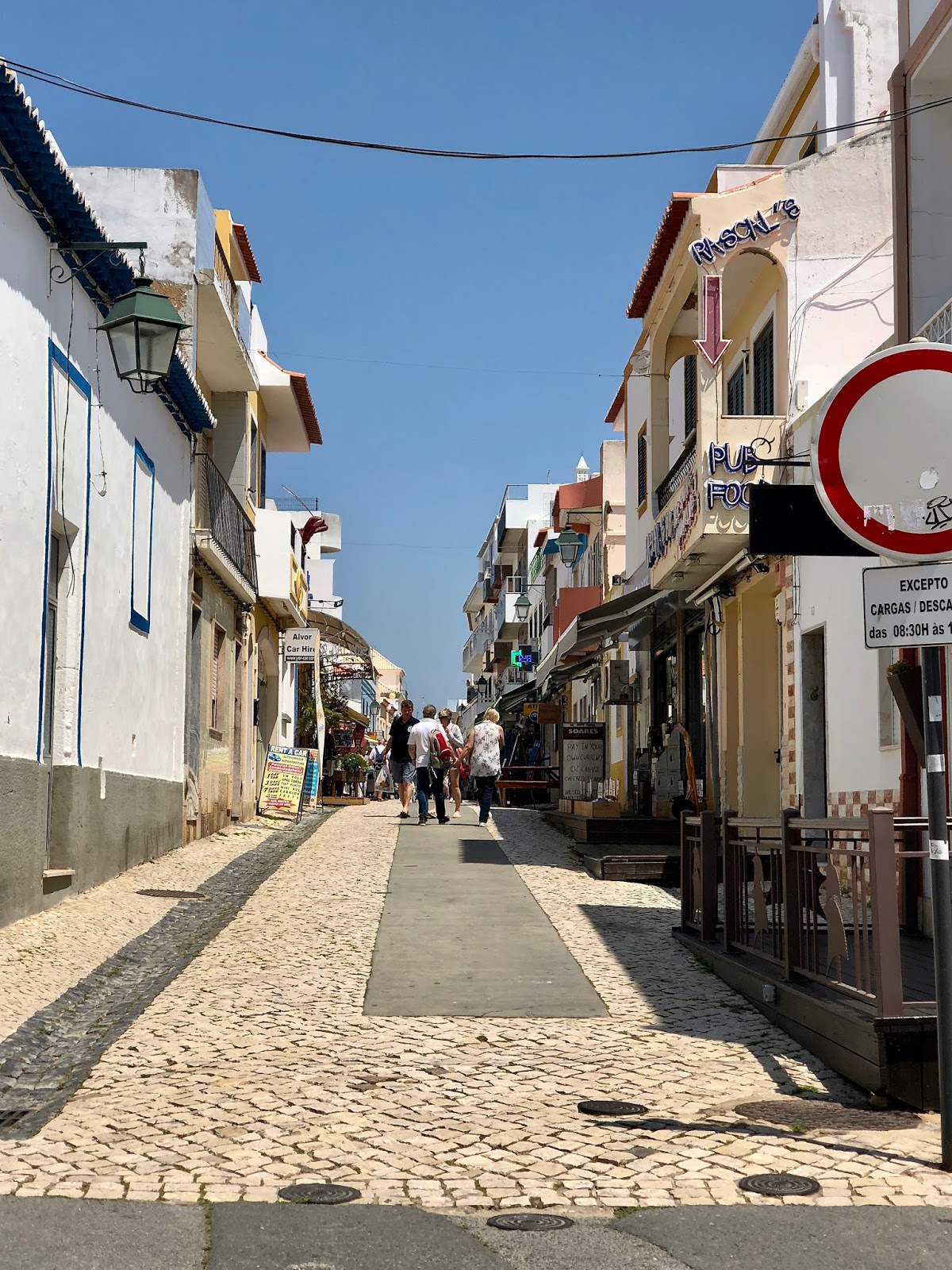
 
Main shopping street in Alvor
After a little walk through Alvor we returned to the ship.  By that time the sun was out and it was getting very hot with little or no shade around, so we decided to stay on the ship and catch up on things.  I should have mentioned that our guide Carla told us that while it doesn’t get extremely cold here in the winter,  the summer can be brutally hot.  Last summer the temperature reached 115 ° .  We couldn’t deal with that!

Anyway, tomorrow we’ll be in Lisbon for an all day tour for just the two of us.  I’ll wrote more when I can. Until then, até mais tarde.

May 7 - Cádiz, Spain


I'm going to apologize in advance for writing so much, but we had a lovely time and these posts and photos, some of which may be boring if you weren't there, help me to remember what we did.

Today we were in Cádiz,  believed by most people to be the oldest continuously inhabited  city in western Europe.  It was founded by the Phoenicians some 3100 years ago.  Some legends say that Hercules was the founder.  The city is at the southwestern corner of Spain and is a peninsula.  Just in the last few months a new bridge costing 625,000,000€ was opened to ease the traffic flow to the mainland of Spain.  The bridge is dramatic and evidently the second longest in Europe.
the bridge from our balcony

We were supposed to take a  tour today but after yesterday’s long march we decided to ditch the tour and do our own thing.  We had just a few thousand of our fellow cruisers in port.  Docked around us were the Queen Mary 2, the Königsdam, Star Breeze (one of Seabourn’s old “little sisters”), and the Sea Dream Yacht Club.  Our original thought was to take a HoHo ride around town but the queue was exceedingly long.  That turned out to be great for us.  We encountered a taxi driver named Diego who named a good price for a tour of Cádiz so off we went.  We have been here before so we have seen many of the sights.  Diego was wonderful! Once he discovered that I could speak Spanish he seemed totally delighted.  He took us through streets that no bus could ever go and that I doubt most cruise passengers have ventured into. 

He took us around the sea wall which has been used in many films to serve as the Malecón, the famous promenade in Havana.  Along there we saw a building which was filmed in a James Bond movie as the palace of Fidel Castro.  Across the street from that is a type of magnolia tree which is more than 475 years old.  Touching a living thing that old is kind of awesome.  We got our fix of religion too because we stopped at several little churches.  One of them has one of the few frescoes ever painted by Picasso.  Since Cádiz is in Andalucía they really celebrate Semana Santa, the week between Palm Sunday, with many processions.  The churches we visited had beautiful statues of the Virgin Mary and other saints dressed in magnificent robes woven of silver and gold.  These are carried out during that week in the various processions. 
 
This building served as Castro's palace in movies
I put this in so you could see the size of the trunk of this tree!
That's a branch we're holding on to


We stopped in the Plaza de San Antonio with beautiful old houses which retained some of the architectural influence of the Moors.  Diego took us into the interior courtyard of one which reminded us of the courtyards in the Alhambra in Granada.  The place has a restaurant on the ground floor which is somehow connected to his family.  If we are ever back here in the evening it looked like a lovely place to try.
 
Church on the Plaza de San Antonio
Look at the beautiful tilework and moorish style arches on this house on the plaza
The interior courtyard

Us in front of the staircase in the lovely courtyard

Diego was an interesting character.  He told us a lot about the immigrants.  Evidently several years ago, Cádiz had a very high crime rate.  The authorities did  a study and found that 76% was being committed by illegal immigrants coming from North Africa.  A referendum was held and it was decided that this would be stopped.  Now when illegals are found they are asked if they have a job and money to support themselves.  If the answer is no, they are given a bag of food and ticket back to North Africa.  Crime has fallen to an almost non-existent level.    
Another interesting thing he told us about was rent control in the old city.  There the houses are three or four stories and very narrow containing usually 3 or 4 apartments.  Under the Franco régime rent controls were imposed so the tenants in those apartments were given essentially life-long contracts at the original rent.  As an example Diego told us that his 91 year old grandmother lives in an apartment that has several hundred square meters (huge by European standards) and only pays 50€ a month rent.  He said her landlord can’t wait for her to die so he can tear down the building, rebuild with 8 or 10 apartments in the same space and rent each for 500 or 600€ per month.  The problem some of the owners encounter is that when they tear down and begin to rebuild, they often find artifacts from as early as the Phoenician period and then have to put everything on hold until the authorities decide what to do with these historical relics.

Well, I’ve rambled on enough.  It was a wonderful day.  Diego told us he loves to cook and he gave us his phone number.  He told us the next time we come to Cádiz to give him a call and he would invite us to his home to eat a paella.  I don’t know that we’d take him up on that, but we’ll definitely call him to take us around.    

Oh, one other he thing he did.  Al has been taking along the same walking stick that we bought a bunch of years ago in Montserrat, Spain.  It’s the one you see him with in the photos I’ve included. Diego gave it a name.  He called it “Don Pepe.”  So that’s the name of the stick from now on.

Monday, May 7, 2018

May 6 - Málaga and Ronda


We arrived in Málaga just around sunrise.  Today was a long and extremely tiring day.  We walked about 6 miles, most of it on cobblestoned streets.  Let me tell you those are killers on the feet!
Sunrise over Málaga

Our tour today took us to the city of Ronda about 65 miles west and inland from Málaga.  Our guide was Nati (short for Natividad) and our driver was Pepe.  We drove along the coast for a bit past some of the Costa del Sol’s resort towns and then we headed into the mountains. After a drive through Spanish fir  and chestnut forests we arrived at the city of Ronda.

Ronda has a population of about 36,000 people and sits  2500 feet above sea level.  The Guadelevin River runs through the city cutting it in two and carving out the 350 foot canyon called El Tajo above which the city is perched.  The canyon is spanned by three bridges.  The newest, the Puente Nuevo, was built in the 18th century.  As with other Spanish cities it has been under the rule of many different groups.  It was for a time a major city of one of the Moorish kings who ruled in Spain.  Following the reconquest it came to be a center for the Spanish Inquisition.
 
El Tajo canyon

Puente Nuevo

Ronda was a favorite place for writers like Hemingway.  In one of the  chapters of For Whom the Bell Tolls he describes Fascist sympathizers being thrown off a cliff in a fictional village and it’s thought he based his description on the cliffs in Ronda.  The city was a favorite of Orson Welles and according to Nati, Welles specified in his will that he be buried in Ronda.  He was cremated and his ashes were interred there.
 
Cafe Hemingway (it seems he was everywhere!)
For Spaniards the city is especially famous for bullfighting.  A family named Romero beginning in the 17th century began the tradition of modern bullfighting.  Pedro Romero in the mid-19th century transformed it from just a prelude to killing a bull to an art form with the use of the cape.  Ronda has the oldest bullring in Spain.
The oldest bullring in Spain
 
Al & Ordoñez (one of the most famous modern bullfighters)  Al needs a cape not a walking stick.
We visited the cathedral which was built on the site of a mosque (the bell tower incorporates the old minaret).  The cathedral is built in two styles, baroque and late Renaissance, because portions were destroyed in an earthquake.  There are two large central altars.  One is made completely of hand-wrought pure silver.  The other is covered completely in gold.
 
Silver altar
Gold altar

After a lot of walking we had a nice lunch at a restaurant across the street from the bullring and named for Pedro Romero.  A brief visit into the bullring ended our stay in Ronda.  Our ride back to Málaga was on a different route which took us past thousands of olive trees and orange and lemon groves.  It was a nice day but we were exhausted!  The cobblestones did us in.


May 5 - A Day at Sea (Finally!)


We had an uneventful day.  Some people don’t like sea days but we enjoy them.  WE slept a little late and our big activity of the day was noon team trivia. Seabourn does this differently from some cruise lines.  Team trivia is a cumulative event so since we have three sea days on this cruise we add the totals from each day to determine the winner.  Each team has no more than 10 players and you pick out a team name.  Ours is “The Globetrotters.” We have 5 Americans and five Australians.  Wonder of wonders, we are in the lead by 20 points after the first day!  I hope I haven’t jinxed us by writing that!

We spent the rest of the day catching up on e-mails and generally being lazy.  The seas were nice and calm and we were always within sight of the Spanish coast.  We were invited to the captain’s table again; last time he hadn’t assumed command yet but now he’s in charge.  He is a delightful young man who I expect will one day be the senior captain for this cruise line or Holland America which is paired with Seabourn in the Carnival Corporation.

Some comments about the food and service are in order.  I think of all our cruises the food this trip has been the best so far as has the service.  We are constantly greeted by name in the dining venues and the staff knows our preferences so they come without ordering them.  The chef looks like he enjoys cooking and food.  I like that; a skinny chef makes me a little suspicious (just kidding).

Anyway it was a great day.  I’ve no photos to post.  I’m still trying to figure this iPhone camera issue out.

May 4 - Ibiza, Spain

-->

Today we arrived at Ibiza, the third largest of the Balearic Islands.  It lies about 93 miles east of Valencia.  The island was settled by the Phoenicians, followed by the Carthaginians, Romans, Vandals, Byzantines, Moors and finally Christian Spaniards.  In other words all the usual suspects have had control of the place.  It’s a small island, roughly 10 times the size of Manhattan.  It appears that the principal industry is tourism and Ibiza is well known for its nightclubs, discos and party life.  In fact it is supposedly the place where electronic “techno” music originated.

We didn’t arrange for a tour today.  The options were limited and mostly involved beaches or 4 X 4 things, neither of which appealed to us.  As it turns out the weather was not totally cooperative for those things either.  It was cloudy and occasionally did a little misting.

We slept late, had a leisurely breakfast  and then took the shuttle bus into the little boat harbor which is close to the city center and old town.  We wandered the streets for a while.  It appeared that many shops were closed.  I wonder if it’s because it isn’t yet the big tourist season.  It’s clear that there are plenty of places to go for partying and nightlife.
Old fort and town
Over the top decorations at a cafe in Ibiza

We eventually found a café that looked nice at the harbor and decided to split a pizza and salad and some wine.  The tables were the size of postage stamps and when the food came Al’s water glass fell and spilled water on his camera.  That little bit killed the camera.  He’s tried drying it with the hair dryer, changing the battery and everything else we could think of to no avail, so the iPhone is now the official photographer.

The food was good and it was interesting people watching.  It never ceases to amaze us that you see every kind of outfit imaginable from the ridiculous to the sublime.  The sky started to look a little threatening so we finished up and headed back on the shuttle.

Today was a special day (a  birthday) and our cabin stewardess had decorated the cabin with balloons, candles, towel animals and a big banner.  There were cards from a variety of ship officers. We had dinner at the alternative restaurant, the Thomas Keller Grill and enjoyed a great meal and a lovely bottle of wine.  When we got back to our cabin there was a birthday cake waiting.  All in all it was a great day and Seabourn did a wonderful job helping us celebrate.

Balloons in our cabin
Birthday Dinner

Cake and a towel elephant

The last couple of photos aren't the best.  We killed Al's camera and somehow I've done something to my iPhone so it won't transfer my pictures to iPhoto so I can't edit them.  Oh well, I see a visit to the Genius Bar at the Apple Store when I get home.

Tomorrow is a sea day. Hurray!

Saturday, May 5, 2018

May 3 - Valencia, Spain

-->

Today we arrived in Valencia.  We have been here before and  have seen the main city sights so we opted for a tour to a place called Xàtiva about an hour and a quarter away.  Let me say a few words about Valencia first.  This is the third largest city in Spain and the fifth largest container port in Europe.  The port is immense!  Probably everyone has heard of Valencia oranges and the region is replete with thousands of orange groves.  I can only imagine what it must look like and smell like to drive through the countryside when the trees are blooming.  In the past Valencia was famous for its cotton and silk industry.  In fact, when I was a child and my family lived in Spain and we visited the area several times I can remember that there were orchards of mulberry trees for the silk worms.

So on to Xàtiva (pronounced za-tea-va) which is a small city with a population of 29,000 on the edge of the fertile coastal plain.  In the 12th century the Arabs brought the technology for making paper to Xàtiva and it became the center of that industry in early Europe.

The town was heavily damaged twice in history.  The first time was during the War of the Spanish Succession in the early 18th century when the Hapsburg and Bourbon heirs fought for the Spanish throne. That war involved nearly all the great powers of the time in Europe with French, Dutch, Austrians, Spanish and British all fighting.  It was as a result of this war, in fact, that Britain acquired Gibraltar in 1714 which is something that has been a major bone of contention between Spain and Britain ever since.

Anyway, Felipe V of the Bourbon family wound up the victor.  Xàtiva had been opposed to his accession to the throne.  After he won he ordered Xàtiva be burned and destroyed as punishment.  When the city was later rebuilt Felipe V’s portrait was hung upside down in the local museum to show the city’s thoughts about him.  Two centuries later during the Spanish Civil Was (1936-1939), the city again suffered significant damage.

There is an old part of the city which has the typical narrow streets lined with tall narrow houses.  There is a small Plaza Mayor in which a market is held two days a week.  The city’s principal claim to fame though is that it is the birthplace of the Borgias, specifically the two Borgia popes.  These were the only two Spanish popes.  The first was Callixtus III and the second was his nephew Alexander VI.  It was the latter who is better known because he was actually something of a rogue.  He openly acknowledged fathering several children  and actively engaged in enriching his family.  Truth be told, he was neither holy nor a nice guy. The cathedral in the town is quite lovely and has statues of the two Borgia popes in front and representations of them inside.
Plaza Mayor in Xàtiva
This was an old hostel from a few hundred years ago which was called the Hostel Pescado (Fish). If you click on the photo you can see the fish hanging between the balconies. Now it's being renovated to be a boutique hotel.

After a brief walking tour we boarded a little “train” (actually a little truck pulling several carriages) to go up the mountain to see the ruins of the castle  overlooking the town and surrounding countryside.  It was a steep ride up and from the drop off point there was an equally steep climb to the foot of the ruins.  From there we opted to stay at the little café in the shade because to attain the summit it looked like there were several hundred steps – not our cup of tea!  We were well entertained though while we waited.  A group of pre-schoolers had ridden up in one of the carriages and they stopped under the trees for their snack and to play some games.  One of their teachers dressed up as a king and led them in some cute exercises. 
View from the castle
This is the summit which we didn't climb to; our knees and backs couldn't take it!
The little pre-schoolers.  They reminded us so much of our grandson.

After everyone finished their climb, we boarded the train and stopped  midway down the mountain at a converted monastery where we had a lovely, but very large lunch.  The food and wine were great with a series of tapas followed by a main course and dessert!

After that interlude it was back down the mountain and onto the bus to Valencia.  I think most people took a little siesta.  It’s easy to understand why Spaniards have that custom after a lunch like the one we ate.

Our ship sailed around 6 PM and we were forecast to have smooth sailing overnight as we made our way to the island of Ibiza.

More later if blogspot and the net cooperate.


May 2 - Barcelona

-->

Today was Barcelona and the end of a cruise for many of our shipmates.  Only 51 of us are continuing on to Dover.  It’s a nice feeling to not have to be off by 9 AM!

A bit of blog information – for almost two days when I tried to post on the blog I got some kind of message that Blogspot had been hacked and it wouldn’t allow me to go there.  Everything else I tried to see online was fine.  Then suddenly when I tried again it worked.  Hurray! 

I’m not going to write anything about the history of Barcelona.  I’ve done that in the past on previous visits.  This remains one of our favorite cities.  We had nothing in particular planned except to walk up and down La Rambla. 

Our ship was docked at the World Trade Center not at the cruise terminal where all the large ships dock.  We were very close to the Columbus Plaza which is at the foot of La Rambla.  We were sort of disorganized this morning.  Al didn’t put on his walking trainers and I forgot to bring my iPhone which is what I’m using as my camera this trip.  We each wore jackets and quickly discovered it was hot as we walked.  Oh, well, it was just one of those days.

So off we went and begin what turned out to be a 6 mile stroll. We walked to the circle and began walking up La Rambla.  There were only 3 or 4 mimes.  I remember the first time we did this walk there were many more.  I guess miming doesn’t pay.  There were however about a zillion tourists walking along.  There are five ships in today plus land vacation tourists.
Not the best shot but just to prove we really did walk by Columbus
When we got up to the Boqueria Market we had to go in.  I have never seen it so crowded!  You could hardly walk and shoving to get through was the order of the day.  We didn’t stay long.  We continued up the street to the Plaça Catalunya.  Al had just about worn out a Hard Rock Barcelona t-shirt with the Sagrada Familia Cathedral on it that we bought years ago and he wanted a new one.  So we went in the store and found the new version.

I just have to put in some market pictures. I can't help myself.
Some luscious produce!
Ham and cheese, anyone?

Hams???
Some peppers and garlic to spice things up

By the time we’d done that it was time to walk back down to the Gothic Quarter to a tapas restaurant we have always enjoyed.  We had a nice assortment of tapas and a good bottle of wine.  (We also got to rest our weary bodies and feet for a little while.)

Then it was back to the ship.  Today was the day our new captain assumed command and Al had teased him at dinner the other night that he would be keeping a close eye on how he made his first departure.  Captain Steven did a great job which was no easy feat since we had a really fresh breeze holding the ship to the dock.

There were lots of VERY large yachts in the harbor.  Some of  them are for charter.  This one, the Naia, can be chartered for a mere  595,000 € plus expenses per week in the low season or 635,000€ plus expenses per week in the high season!  Of course she does take 12 passengers.  Anyone care to form a group and charter her???
MV Naia - too rich for our blood!

So now we’re on the second leg of our cruise with our next port of call in Valencia tomorrow.  The weather is supposed to be good and the seas should be calm tonight.